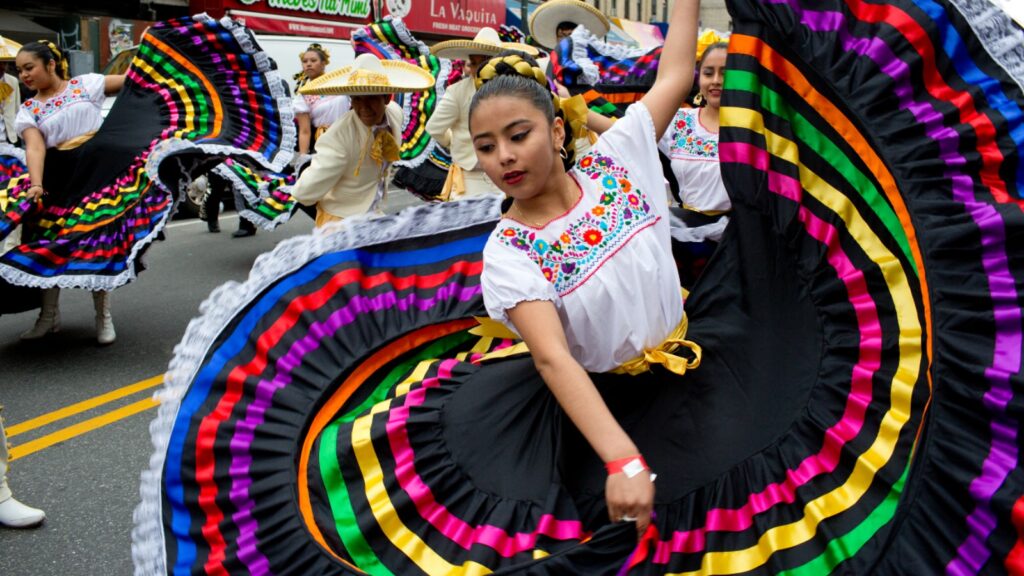
Much of the colorful and intricate embroidery found here is from Chiapas, some from other central American countries. Traditionally, these works were painstakingly done by hand, Nowadays, sewing machines increase production time.
Puerto Vallarta, Mexico – Mexico has long been known for its talented artists and craftsmen. Some techniques date back hundreds of years. Many of Vallarta’s shops and galleries carry these beautiful, handmade pieces. The following is only a brief summary, some examples of which can be seen on some of my walking tours.
Huichol Bead and Thread
Since the early 1700s when Spanish missionaries arrived here with their Czechoslovakian glass beads in hopes of converting the indigenous people to Catholicism, the Huicholes have created amazing colorful animals and masks of all sizes. These are carved wood, clay, and animal skulls intricately covered with these beads depicting the 43 spiritual symbols by which they live. These colorful beads are adhered using a special mixture containing the bees wax prevalent in their mountainous areas.
Embroidery threads, long used in clothing and other articles, is now used to create their beautiful and symbolic thread paintings. Again the threads are adhered to a flat piece of wood using the same wax adhesive. Each of these works of art are done by hand and are original in that the artist creates the designs as he goes. New more contemporary designs are starting to appear as younger artists bring new ideas and energy to their work.
Alebrijes
Several of the indigenous communities in the mountains of Chiapas are known for their hand carved wooden animals using local copal wood. These are often imaginative and fanciful with exaggerated ears or protruding eyes. Once carved they are painstakingly hand painted using micro tools to produce the fine details on each piece which are also one of a kind.
Weaving
For hundreds of years, the weaving of local cotton has been part of the everyday activity of the villages. Done mainly by the women using Mayan backstrap looms, these materials were turned into daily clothing and special garments for celebrations. Each village has it own style and symbology woven into the cloth. The most commonly recognized garment today is the huipil, a long shirt worn over a skirt or pants.
Embroidery
Much of the colorful and intricate embroidery found here is from Chiapas, some from other central American countries. These works have always been painstakingly done by hand using natural dyes. Now however the arrival of the sewing machine has helped to increase production time. Chemical dyes have also been introduced giving the artist a wider selection of colors to work with. Many symbols are also used which reflect the region where the artist lives.
Tin Work
Pounded sheet metal is the creative activity originally from San Miguel de Allende. Artists from this area have long been recognized for their beautiful lanterns, furniture, mirrors, toys and religious images. Patterns are created using nails pounded into a wooden base. The sheet metal is layed on top and hammered until the patterns appear in the metal. The artist continues to work until the piece is done. Some are so intricate and large that it takes months to finish.
Arbol de las Vidas
Trees of Life have been part of many cultures for centuries. In Mexico, these are made of ceramic clay mainly in the central areas of Metepec and Izucar. Originally designed after the candelabras and incense burners of the ancient churches, pieces today have evolved into many styles depending on the artist. Some still depict Adam and Eve and the serpent, but others have different themes, including Day of the Dead. Hand-painted and fired, these creations can be found in many shops and galleries throughout Puerto Vallarta.
Papel Amate
These lovely hangings are intricately cut and woven pieces of tree bark. Light colored bark is from the mulberry tree; the darker bark from the wild fig or ficus tree. This ancient tradition is still used today in the area of the Otomi peoples in the rugged mountains of northern Puebla and Veracruz. Originally used for important documents and clothing, these pieces are now popular world-wide for decorative art and museum collections.
We provide information and resources for visitors to Puerto Vallarta, areas of The Riviera Nayarit and other destinations in both states of Jalisco and Nayarit . You will find variety of content, including articles, blog posts, videos, photos, descriptions and interviews, all of which are designed to help visitors plan their trip, including attractions, restaurants, and events. https://promovisionpv.com/
El destino fue invitado al Commissionaires Ottawa Open, evento que reúne a 156 golfistas profesionales de todo el mundo.
Del 22 al 28 de julio, Puerto Vallarta se promociona en el Abierto de Golf Commissionaries que se está llevando a cabo en el campo de golf de Eagle Creek en Ottawa, capital de Canadá. Este evento forma parte del Tour Americas de la Asociación Profesional de Golfistas (PGA).
El torneo internacional consta de 6 eventos en Sudamérica y 10 en Canadá con la participación de 156 golfistas profesionales de todo el mundo, entre ellos los mexicanos Fernando Arzate, Isidro Benítez, Rodolfo Cazaubón, Armando Favela, Luis Gerardo Garza, José de Jesús Rodríguez y Jorge Villar.
A través del mundo del golf, el PGA Tour genera un impacto positivo al apoyar y mejorar las comunidades locales. Desde 2013, el PGA Tour en Canadá ha donado más de 6 millones de dólares a organizaciones de beneficencia en todo el país. En esta ocasión, los fondos serán destinados a la recuperación de miembros lesionados y veteranos de las Fuerzas Armadas canadienses, brindándoles recursos y oportunidades a través de actividades deportivas, recreativas y creativas.
La Embajada de México en Canadá invitó a entidades de la República Mexicana con vocación golfística al Abierto de Ottawa para representar al país. Puerto Vallarta acudió al llamado para promover sus campos de golf y el destino en general, representado en esta ocasión por los campos de golf Marina y Vista Vallarta.
Además de promocionar los vuelos directos que existen desde Ottawa a Puerto Vallarta en la temporada otoño invierno, se ofrecieron paquetes de hospedaje con rondas de golf a los jugadores y espectadores del Pro-Am, quienes se mostraron sumamente atraídos por las bondades y atractivos turísticos del principal destino de playa jalisciense.
El Fideicomiso de Turismo de Puerto Vallarta, comentó: “El golf sigue siendo un gran atractivo de nuestro destino; contamos con varios campos de campeonato diseñados por reconocidos ex golfistas profesionales y somos la sede oficial del México Open, otro importante torneo de la PGA y el más importante de nuestro país”.
De esta manera, Puerto Vallarta continúa posicionándose como destino turístico líder para el nicho de golf, con 12 campos de golf de talla internacional en su zona metropolitana y hoteles de lujo orientados a atender este sector de la industria.
Brindamos información y recursos para visitantes de Puerto Vallarta, áreas de la Riviera Nayarit y otros destinos en ambos estados de Jalisco y Nayarit. Encontrará una variedad de contenido, incluidos artículos, publicaciones de blogs, videos, fotografías, descripciones y entrevistas, todos los cuales están diseñados para ayudar a los visitantes a planificar su viaje, incluidas atracciones, restaurantes y eventos. https://promovisionpv.com/
Puerto Vallarta es un Destino Seguro de Vacaciones
Puerto Vallarta es buscado por muchos turistas tanto nacionales como internacionales que son atraídos por su espectacular ubicación geográfica, una bahía considerada como una de las más bellas del mundo, rodeada por la Sierra Madre Occidental que hacen de esta ciudad un lugar bendecido por la naturaleza.
Pero si esto fuera poco, el destino ha logrado mantenerse en un ambiente amable donde predomina la hospitalidad y la calidez de la gente, y puede garantizar a sus visitantes una estadía libre de contratiempos y la mejor experiencia de sus vacaciones, como lo constatan miles de viajeros cada año.
Puerto Vallarta no sólo es un bello destino sino uno de los más seguros del país y eso sin duda, atrae el interés de los viajeros”.
Durante su estadía, hay múltiples actividades que Puerto Vallarta ofrece a los turistas y es que bien pueden disfrutar simplemente del excelente destino de sol y playa o también elegir un paseo por el malecón ya sea de día o de noche, visitar los restaurantes o disfrutar de la vida nocturna con un recorrido por los antros de moda a lo largo del malecon.
Y es que la garantía de seguridad que esta ciudad ofrece, les permite realizar cualquier actividad, incluso realizar algún deporte extremo como un lanzamiento en el Bungee o subir la adrenalina al deslizarse en el Canopy enclavado en las montañas.
Para quienes gustan de visitar los pueblos cercanos a Puerto Vallarta, pueden hacerlo con toda seguridad a través de caminos de terracería que son recorridos con cuatrimotos o automóviles areneros, una actividad que cada vez cobra más adeptos.
Sin duda el visitante encontrará algo qué hacer durante sus vacaciones con la certeza y tranquilidad de que esta puede ser la mejor experiencia al contar con una amplia gama de actividades a elegir ya sea en el mar o en tierra, de día o de noche.
Las caminatas por el malecón, visita a los restaurantes, bares, deportes extremos y actividades acuáticas son algunas de las experiencias que se pueden vivir con la garantía que ofrece un destino hospitalario y donde seguro te enamoras.
Brindamos información y recursos para visitantes de Puerto Vallarta, áreas de la Riviera Nayarit y otros destinos en ambos estados de Jalisco y Nayarit. Encontrará una variedad de contenido, incluidos artículos, publicaciones de blogs, videos, fotografías, descripciones y entrevistas, todos los cuales están diseñados para ayudar a los visitantes a planificar su viaje, incluidas atracciones, restaurantes y eventos. https://promovisionpv.com/
La diversidad de Puerto Vallarta ofrece alternativas para todos los gustos y bolsillos, por eso una zona que el turista no debe dejar de visitar es Fluvial Vallarta.
Esta zona residencial y comercial ofrece un gran atractivo para los paseantes y es que entre sus casas y cotos privados, se pueden observar amplios camellones con longevos árboles que son el escenario ideal para bellas fotografías.
Costco
Además de su paisaje y tranquilidad, en esta zona, con la mejor ubicación y a tan sólo 100 metros de la playa, se encuentran también algunos restaurantes, bares y comercios que ofrecen lo mejor a quienes los visitan.
Para quienes gustan de buena comida, ahí puede visitar restaurantes de gran tradición en Puerto Vallarta como Los Alcatraces que ofrece servicio de desayuno, comida y cena, con una gran variedad de platillos y la especialidad, los mejores chilaquiles de Vallarta.
La Comer
Recientemente se inauguró al ingreso de Fluvial, por la avenida de ingreso de Puerto Vallarta, la Plaza Altamar en donde se ubica el restaurante Asador La Vaca Argentina, donde se puede degustar una gran variedad de cortes; también está el Marinero Ranchero y La Dolce, este último de cocina italiana.
En ese mismo sitio se ubica la discoteca de moda en Puerto Vallarta, La Santa que a poco tiempo de su apertura ha logrado capturar la atención de la gente local y turistas, el lugar está espectacular, cuenta con dos secciones que a su vez tienen dos diferentes ambientes y dos espectaculares cabinas para sus DJ’s residentes.
Una es el área de la discoteca y la otra es el área lounge
Brindamos información y recursos para visitantes de Puerto Vallarta, áreas de la Riviera Nayarit y otros destinos en ambos estados de Jalisco y Nayarit. Encontrará una variedad de contenido, incluidos artículos, publicaciones de blogs, videos, fotografías, descripciones y entrevistas, todos los cuales están diseñados para ayudar a los visitantes a planificar su viaje, incluidas atracciones, restaurantes y eventos. https://promovisionpv.com/
Hay historias que para contarlas, primero debes vivirlas.
Bienvenido a un destino Auténtico. Extraordinario. Vibrante. Puerto Vallarta: Pacific & Wild Auténtico. Extraordinario. Vibrante. Explora la dualidad de la costa del Pacífico
Las exuberantes montañas de la Sierra Madre y el majestuoso
Océano Pacífico crean un escenario único, pacífico y emocionante,
que te llevarán a descubrir tu propia energía y vitalidad.
Brindamos información y recursos para visitantes de Puerto Vallarta, áreas de la Riviera Nayarit y otros destinos en ambos estados de Jalisco y Nayarit. Encontrará una variedad de contenido, incluidos artículos, publicaciones de blogs, videos, fotografías, descripciones y entrevistas, todos los cuales están diseñados para ayudar a los visitantes a planificar su viaje, incluidas atracciones, restaurantes y eventos. https://promovisionpv.com/
Migration Les frais de non-résident Douane Marchandises que vous pouvez importer au Mexique sans payer de taxes Liste des articles qui composent les bagages personnels La défiscalisation Produits interdits Importer des médicaments au Mexique pour un usage personnel uniquement Amener des animaux de compagnie au Mexique (chiens et chats) Cas dans lesquels vous devez payer des impôts Aduanas(Douanes)
Les ressortissants étrangers entrant au Mexique par voie aérienne devront obtenir le formulaire numérique de migration multiple (FMMD pour son acronyme en espagnol), afin de faciliter et d’accélérer les procédures d’immigration.
Ce formulaire d’inscription accrédite la situation migratoire régulière en tant que touriste, visiteur d’affaires et autres. Le ressortissant étranger disposera de 60 jours calendaires pour télécharger son FMMD après son entrée dans le pays.
Les agents de migration examineront et tamponneront le passeport ou le document de voyage et fixeront la date estimée de départ du pays, en fonction de la période temporaire accordée.
Dans le cas où le FMMD subit une destruction partielle ou totale, est volé, perdu ou n’est pas téléchargé dans un délai de 60 jours calendaires, une démarche de remplacement doit être effectuée. Le ressortissant étranger pourra visualiser les codes QR dans les filtres d’immigration pour accéder au microsite suivant : https://www.inm.gob.mx/spublic/portal/inmex.html
Les ressortissants étrangers qui souhaitent entrer au Mexique par voie terrestre doivent remplir un formulaire FMME qui peut être obtenu en ligne : https://www.inm.gob.mx/fmme/publico/en/solicitud.html Remplissez ce formulaire avec vos informations individuelles.
Au point d’entrée au Mexique, l’agent de migration déterminera la durée du séjour au Mexique du ressortissant étranger.
La durée maximale du séjour des visiteurs (touristes et visiteurs d’affaires) au Mexique est de six mois maximum.
La durée maximale du séjour des visiteurs en transit est de 30 jours.
Le titulaire d’un visa de résident temporaire ou d’un visa de résident permanent, dans les 30 jours suivant son entrée au Mexique, doit obtenir, en conséquence, la carte de résident temporaire ou la carte de résident permanent auprès de l’Institut national des migrations.
Les autorités migratoires mexicaines ont la faculté d’accorder ou de refuser l’entrée au Mexique si le visiteur ne respecte pas pleinement la réglementation migratoire. Pour plus d’informations, veuillez cliquer sur les liens suivants : a) dépliant ; b) conditions pour entrer au Mexique (en espagnol)
L’agent d’immigration tamponnera le formulaire FMM à son arrivée. Veuillez le conserver dans un endroit sûr et ne le perdez pas. Le FMM vous sera demandé à votre départ du Mexique, en cas de visiteurs ; ou pour obtenir la Carte de Résident Temporaire ou la Carte de Résident Permanent, dans le cas des titulaires d’un visa de résident temporaire ou d’un visa de résident permanent.
Que sont les portes électroniques (e-Gates) de l’aéroport et à propos des aéroport Mexicain. ÊTRE AU COURANT! https://promovisionpv.com/que-sont-les-portes-electroniques-e-gates-de-laeroport-et-a-propos-des-aeroport-mexicain-etre-au-courant/
Les frais de non-résident
Comme de nombreux pays, depuis 1999, le Mexique impose des frais pour l’autorisation de séjour migratoire à but non lucratif. Les ressources collectées grâce à cette taxe sont utilisées pour la promotion du tourisme au Mexique et pour l’assistance et l’amélioration des services migratoires. Ces frais sont mis à jour chaque année. Le moment et le mode de paiement varient en fonction du mode et de l’itinéraire que vous utilisez pour entrer dans le pays.
Lorsque vous voyagez en avion pour entrer au Mexique, les frais sont généralement inclus dans le billet d’avion.
Pour plus d’informations, vous pouvez visiter le site de l’Institut National des Migrations
Marchandises que vous pouvez importer au Mexique sans payer de taxes
La franchise
Selon le moyen de transport par lequel vous entrez au Mexique, les ressortissants étrangers peuvent emporter avec eux des marchandises sans payer de taxes, en plus de leurs bagages personnels. Par voie aérienne, la franchise peut atteindre 500 dollars américains et par voie terrestre, jusqu’à 300 dollars américains.
La franchise à laquelle a droit chaque membre de la famille peut se cumuler s’ils voyagent ensemble dans le même moyen de transport, sauf s’ils sont résidents de la bande ou de la région frontalière.
Vous pouvez démontrer la valeur de la marchandise faisant partie de la franchise avec des factures ou des reçus de vente. En cas de non-disponibilité de ces éléments, le personnel des douanes pourra déterminer la valeur de la marchandise. Avec votre franchise vous ne pouvez pas introduire de boissons alcoolisées, de tabacs sculptés, de carburant automobile, sauf celui qui est contenu dans le réservoir de carburant de votre véhicule.
Nota Bene.- Cette page est uniquement informative.- Pour plus d’informations, vous pouvez consulter le site des douanes mexicaines : https://anam.gob.mx/equipaje-y-franquicia/
Liste des articles qui composent les bagages personnels
Marchandises
Biens à usage personnel, tels que vêtements, chaussures, articles de toilette et produits de beauté, s’ils correspondent à la durée du voyage. Ils comprennent également un trousseau de mariée, des articles pour bébé (une chaise, un berceau portatif, une poussette, un trotteur, entre autres, et leurs accessoires).
2 appareils photo ou caméras d’enregistrement vidéo ; matériel photographique; 3 téléphones mobiles ou autres réseaux sans fil ; un équipement de positionnement global (GPS) ; un bloc-notes électronique ; un ordinateur portable, un ordinateur portable, un omnibook ou similaire ; un copieur ou une imprimante portable ; un graveur DVD et un projecteur portable, avec ses accessoires.
2 équipements sportifs personnels, 4 cannes à pêche, 3 planches à voile avec ou sans voile et leurs accessoires, trophées ou reconnaissances, s’ils peuvent être transportés communément et normalement par le passager.
Un appareil portable d’enregistrement ou de reproduction du son ou mixte ou 2 appareils d’enregistrement ou de reproduction numérique d’images et de sons et un lecteur DVD portable ; un ensemble d’enceintes portables et leurs accessoires.
5 disques laser, 10 disques DVD, 30 disques compacts, 3 logiciels et 5 périphériques de stockage pour tout équipement électronique.
Livres, magazines et documents imprimés.
5 jouets, dont des objets de collection, une console de jeux vidéo et 5 jeux vidéo.
Un appareil de mesure de la tension artérielle et un autre de mesure du glucose ou du mélange et ses réactifs. Médicaments à usage personnel (dans le cas de substances psychotropes, la prescription médicale doit être présentée).
Valises, malles ou tout autre objet nécessaire au transfert des bagages.
Une jumelle et un télescope.
2 instruments de musique et leurs accessoires.
Une tente et autre matériel de camping.
Un ensemble d’outils à main avec son étui, pouvant comprendre une perceuse, des pinces, des clés, des douilles, des tournevis, des cordons d’alimentation, entre autres.
Passagers de plus de 18 ans, maximum 10 paquets de cigarettes, 25 cigares ou 200 grammes de tabac ; jusqu’à 3 litres de boissons alcoolisées et 6 litres de vin.
Personnes âgées et personnes handicapées, articles qui, en raison de leurs caractéristiques, remplacent ou réduisent leurs limitations, comme les déambulateurs, les fauteuils roulants, les béquilles, les cannes, entre autres.
Nota Bene.- Cette page est uniquement informative.- Pour plus d’informations, vous pouvez consulter le site des douanes mexicaines : https://anam.gob.mx/equipaje-y-franquicia/
Produits interdits
Conformément à la « Loi sur les taxes générales à l’importation et à l’exportation », l’introduction des produits suivants dans le pays est interdite :
Armes à feu, sauf à des fins de chasse, pour autant que les règles indiquées au. Poissons prédateurs vivants aux stades alevins, juvéniles et adultes. Sulfate de thallium Totoaba, frais ou réfrigéré (poisson) Insecticide (Isodrin, Aldrin, Heptachloro, Drinox, Endrin, Mendrino, Nendin, Hecadrin ou Leptofos) Totoaba surgelé (poisson) Oeufs de tortues de toutes sortes Graines de pavot (pavot à opium) Imide d’acide N-phtalilglutamique (Thalidomide) Farine de graines de pavot (pavot à opium) Graines et spores de marijuana (Cannabis Indica), même mélangées à d’autres graines Héroïne, base ou chlorhydrate de diacétylmorophine Marijuana (Cannabis Indica) Préparations médicinales à base de marijuana (Cannabis Indica) Jus et extraits d’opium préparés pour être fumés Préparations médicales à base d’acétylmorphine, de ses sels ou dérivés. Extraits et jus dérivés de marijuana (Cannabis Indica) Peaux de tortue ou de tortue verte Mucilages et épaississants dérivés de la marijuana (Cannabis Indica)
Timbres imprimés en couleurs ou en noir et blanc, présentés à la vente dans des enveloppes ou des paquets, même s’ils contiennent du chewing-gum, des bonbons ou tout autre type d’articles, contenant des dessins, figures ou illustrations représentant l’enfance de manière dénigrante ou ridicule. , dans des attitudes incitant à la violence, à l’autodestruction ou à tout autre type de comportement antisocial, connus sous le nom de “Garbage Pail Kids”, par exemple, imprimés par n’importe quelle entreprise ou dénomination commerciale.
Le Ministère de l’Agriculture interdit les marchandises suivantes car elles représentent un grand risque d’introduction de pestes et de maladies : terre, paille, conteneurs de foin rembourrés, décorations en paille sans transformation ; aliments faits maison; farines d’origine animale; viandes et produits carnés frais, secs, en conserve ou surgelés, tels que les saucisses fumées, salées et affinées, élaborés dans des pays sous quarantaine absolue (Europe, Afrique, Asie et Amérique du Sud). Pour plus d’informations, veuillez visiter le site Web www.sagarpa.gob.mx
Importer des médicaments au Mexique pour un usage personnel uniquement
Les passagers voyageant avec des médicaments à usage personnel sont autorisés à entrer dans le pays (quel que soit le composant actif) à condition d’apporter leur ordonnance ou une lettre de leur médecin généraliste dans laquelle il doit indiquer la quantité de substance requise par le patient pendant son ou son séjour au Mexique, la quantité apportée dans le pays et la dose quotidienne.
Au port d’entrée, vous devez déclarer aux autorités douanières et présenter la prescription médicale ou l’autorisation délivrée par l’autorité compétente. Le premier doit indiquer le nom du médecin autorisant la prescription, sa signature, ses coordonnées (téléphone, adresse) et son registre professionnel. L’ordonnance ou l’autorisation médicale doit également indiquer la quantité de substance requise par le patient pendant son séjour au Mexique, la quantité introduite dans le pays et la dose quotidienne. Les médicaments ne doivent pas dépasser la quantité nécessaire à votre séjour dans le pays. L’ordonnance doit être traduite en espagnol.
Amener des animaux de compagnie au Mexique (chiens et chats)
Exigences:
Contactez le personnel officiel du SENASICA pour obtenir un certificat d’importation pour votre animal de compagnie.
L’agent procédera alors à une inspection physique et documentaire pour vérifier le respect des exigences suivantes :
Présenter un certificat de bonne santé original (avec une copie non certifiée conforme) valable au moins 15 jours après sa délivrance et contenant les éléments suivants :
Le certificat doit être délivré soit par un vétérinaire officiel de l’autorité compétente, soit par un vétérinaire exerçant en pratique privée. S’il est délivré par cette dernière, l’attestation doit être imprimée sur papier à en-tête de l’entreprise avec le numéro de licence professionnelle imprimé, ou une photocopie de celle-ci (ou un équivalent.) Nom et adresse de l’exportateur (pays d’origine ou de départ) et de l’importateur (adresse de destination au Mexique). Date d’application du vaccin antirabique et validité de celui-ci (les animaux de moins de 3 mois sont exemptés de cette exigence.) Le ou les animaux doivent avoir été jugés cliniquement sains lors de l’inspection précédant leur voyage. Le ou les animaux doivent avoir été vermifugés/épouillés au cours des six derniers mois et doivent être exempts d’ectoparasites. En cas de non-respect de ce qui précède, contactez un vétérinaire au Mexique (de votre choix et à vos frais), qui appliquera le(s) traitement(s) correspondant(s) et délivrera le certificat sanitaire.
Votre animal doit être transporté dans une cage ou un contenant propre, sans lit, sans ustensiles ni accessoires (jouets, friandises ou autres articles fabriqués avec des ingrédients de ruminants) ; sinon, ces objets seront retirés pour être détruits. La caisse ou le conteneur subira un traitement préventif par pulvérisation effectué par le personnel officiel du Secrétariat à l’Agriculture-SENASICA. Votre animal peut entrer avec son collier, sa laisse, etc.
Vous pouvez emporter une ration quotidienne d’aliment équilibré en vrac. Nous vous rappelons que ce type d’aliment est disponible à l’achat au Mexique et est enregistré et autorisé par le SENASICA.
Si vous documentez votre animal de compagnie comme fret, vérifiez les exigences auprès de la compagnie aérienne de votre choix et envisagez d’utiliser les services d’un agent en douane pour le traitement et la libération de votre animal de compagnie des douanes.
Pour plus d’informations, veuillez consulter les liens suivants :
Lorsque vous envisagez d’introduire au Mexique tout autre animal domestique autre qu’un chat ou un chien, vous devez vous conformer à ce qui est indiqué dans le module de consultation des exigences zoosanitaires d’importation : https://sistemasssl.senasica.gob.mx/mcrz/
Les animaux, les plantes et leurs produits peuvent entrer au Mexique en fonction de leur pays d’origine et des conditions sanitaires du pays. Ces procédures doivent être strictement respectées afin de prévenir la propagation des épidémies et des maladies à haut risque au Mexique.
Cas dans lesquels vous devez payer des impôts
Si vous entrez par voie terrestre, vous avez le droit d’apporter jusqu’à 75 $ US de marchandises en plus des marchandises incluses dans vos bagages personnels, et vous êtes autorisé à combiner ce montant avec des membres de votre famille.
Si vous entrez par avion, vous avez le droit d’apporter jusqu’à 300 $ US de marchandises en plus des marchandises incluses dans vos bagages personnels, et vous êtes autorisé à combiner ce montant avec les membres de votre famille.
Si vous dépassez cette exonération ou si le montant combiné de votre famille dépasse l’exonération combinée, mais que la valeur des biens ne dépasse pas trois mille dollars, il existe un taux forfaitaire de droits et taxes de 15 %, qui s’applique uniquement au montant dépassant l’exonération (individuelle ou combinée). Vous devez remplir un formulaire de paiement, disponible au comptoir des douanes.
Si la valeur des marchandises dépasse trois mille dollars (par membre de la famille) après soustraction de l’exonération de 75 $ US pour une entrée par voie terrestre ou de 300 $ US pour une entrée par voie aérienne, ou si l’une des marchandises est soumise à des réglementations ou restrictions non tarifaires, vous devez retenir les services d’un courtier en douane
ADUANAS
Une fois sur le territoire mexicain, vous serez libre de voyager et de circuler à l’intérieur ou sans avoir à remplir d’autres formulaires migratoires. Ils ne pourront demander la présentation de formulaires de déclaration en douane que lorsque vous quittez une ville proche d’une frontière et vous dirigez vers une autre à l’intérieur du même pays.
Nota bene.- Ces informations sont fournies à titre de service au public. Il vous est donc conseillé de le vérifier directement auprès des autorités douanières en visitant les sites internet suivants : https://anam.gob.mx/
La plupart des informations contenues dans ce menu font partie du manuel d’entrée touristique préparé par la Secretaría de Turismo, l’Agencia Nacional de Aduanas de México, Banjercito, l’Instituto Nacional de Migración, la Secretaría de Comunicaciones y Transportes et la Secretaría de la Defensa. National. Le manuel d’entrée touristique peut être téléchargé sur le site Internet de La Secretaría de Turismo.
Nous fournissons des informations et des ressources aux visiteurs de Puerto Vallarta, des régions de la Riviera Nayarit et d’autres destinations dans les deux États de Jalisco et de Nayarit. Vous trouverez une variété de contenus, notamment des articles, des articles de blog, des vidéos, des photos, des descriptions et des interviews, tous conçus pour aider les visiteurs à planifier leur voyage, y compris les attractions, les restaurants et les événements. Puerto Vallarta en Français https://promovisionpv.com/francais/
Migration The Non-Resident Fee Customs Goods that you may bring into Mexico without paying taxes List of articles that make up personal luggage The tax exemption Prohibited products Bringing medication into Mexico for personal use only Bringing pets into Mexico (dogs and cats) Cases in which you must pay taxes Aduanas(Customs)
Foreign nationals enter Mexico by air will have to obtain the Digital Multiple Migratory Form (FMMD for its acronym in Spanish), as a way of facilitating and expediting immigration procedures.
This registration form accredits the regular migratory situation in the modality of tourist, business visitor and others. The foreign national will have 60 calendar days to download their FMMD after entering the country.
The migration agents will review and stamp the passport or travel document and will place the estimated date of departure from the country, according to the temporary period granted.
In the event that the FMMD suffers a partial or total destruction, is stolen, lost or is not downloaded within 60 calendar days, a replacement process must be carried out. The foreign national will be able to view the QR codes in the immigration filters to access the following micro site: https://www.inm.gob.mx/spublic/portal/inmex.html
At the port of entry to Mexico, the Migration official will determine the duration of stay in Mexico of the foreign national.
The maximum stay for visitors (tourists and business visitors) in Mexico is up to six months.
The maximum stay for visitors in transit is up to 30 days.
The holder of a temporary resident visa or permanent resident visa, within the 30 days after entering Mexico, must obtain, accordingly, the Temporary Resident Card or Permanent Resident Card before the Migration National Institute.
The Mexican migratory authorities have the faculty to grant or deny the entry into Mexico if the visitor does not fully comply with the migratory regulations. For additional information, please click on the following links: a) leaflet; b) requirements to enter Mexico (in Spanish)
The immigration officer will stamp the FMM form upon arrival. Please keep it in a safe place and do not lose it. You will be asked for FMM at your departure from Mexico, in cases of visitors; or to obtain the Temporary Resident Card or Permanent Resident Card, in cases of holders of temporary resident visa or permanent resident visa.
As many countries, as of 1999 Mexico charges a fee for the authorization of non-lucrative visitor migration stay. The resources collected through this fee are used for the promotion of tourism in Mexico and for the assistance and improvement of migratory services. This fee is updated annually. The time and manner of paying it varies according to the mode and route you use to enter the country.
When traveling by plane to enter Mexico, the fee is mostly included in the flight ticket.
For more information, you can visit the website of the Migration National Institute
Goods that you may bring into Mexico without paying taxes
Franchise
Depending on the means of transport you enter Mexico, foreign nationals can bring with them merchandise without paying taxes, in addition to their personal luggage. By air the franchise is up to $500 US dollars and by land is up to $300 US dollar.
The excess to which each member of the family is entitled can accumulate if they travel together in the same means of transport, except if they are a resident of the strip or border region.
You can demonstrate the value of the merchandise that is part of the franchise with invoices or sales receipts. In case of not having these, the customs personnel will be able to determine the value of the merchandise. With your franchise you cannot introduce alcoholic drinks, carved tobaccos, automotive fuel, except that which is contained in the fuel tank of your vehicle.
Goods for personal use, such as clothing, footwear, toiletries, and beauty products, if they are accordingly with the duration of the trip. They also include a bridal trousseau, baby items (a chair, a portable crib, a stroller, a walker, among others, and their accessories).
2 photographic or video recording cameras; photographic material; 3 mobile telephones or other wireless networks; a global positioning equipment (GPS); an electronic notepad; a laptop, notebook, omni book or similar; a portable copier or printer; a DVD burner and a portable projector, with its accessories.
2 personal sports equipment, 4 fishing rods, 3 sailboards with or without a sail and their accessories, trophies, or recognition, if they can be transported commonly and normally by the passenger.
A portable sound recording or reproducing or mixed device or 2 for digital image and sound recording or reproducing apparatus and a portable DVD player; a set of portable speakers, and their accessories.
5 laser discs, 10 DVD discs, 30 compact discs, 3 software packages and 5 storage devices for any electronic equipment.
Books, magazines, and printed documents.
5 toys, including collectibles, a video game console and 5 video games.
A device for measuring blood pressure and one for measuring glucose or mixed and its reagents. Medications for personal use (in the case of psychotropic substances, the medical prescription must be shown).
Suitcases, trunks or any other item necessary for the transfer of luggage.
A binocular and a telescope.
2 musical instruments and their accessories.
A tent and other camping gear.
A set of hand tools with its case, which may include a drill, pliers, wrenches, sockets, screwdrivers, power cords, among others.
Passengers over 18 years of age, a maximum of 10 cigarette packs, 25 cigars or 200 grams of tobacco; up to 3 liters of alcoholic beverages and 6 liters of wine.
Older adults and people with disabilities, items that due to their characteristics replace or reduce their limitations, such as walkers, wheelchairs, crutches, canes, among others.
In accordance with the “Law of General Import and Export Taxes”, the introduction of the following products into the country is prohibited:
Firearms, except for hunting purposes, as long as the rules indicated in.
Live predatory fish in their fingerling, juvenile, and adult stage.
Thallium Sulfate
Totoaba, fresh or refrigerated (fish)
Insecticide (Isodrin, Aldrin, Heptachloro, Drinox, Endrin, Mendrino, Nendin, Hecadrin, or Leptofos)
Frozen Totoaba (Fish)
Turtle eggs of any kind
Poppy seeds (Opium Poppy)
Imide of N-phtalilglutamic acid (Thalidomide)
Poppy seed flour (Opium Poppy)
Marijuana (Cannabis Indica) seeds and spores, even when mixed with other seeds
Heroin, base, or Diacetylmorophine hydrochloride
Marijuana (Cannabis Indica)
Medicinal preparations based on marijuana (Cannabis Indica)
Opium juices and extracts prepared for smoking
Medical preparations based on acetylmorphine, its salts or derivatives.
Extracts and juices derived from marijuana (Cannabis Indica)
Turtle or Green Turtle skins
Mucilages and thickeners derived from marijuana (Cannabis Indica)
Stamps printed in colours or in black and white, presented for sale in envelopes or packets, even when they include chewing gum, candy, or any other type of articles, containing drawings, figures, or illustrations that portray childhood in a denigrating or ridiculous manner, in attitudes which incite violence, self-destruction, or any other type of anti-social behaviour, know as “Garbage Pail Kids”, for example, printed by any company or commercial denominations.
The Ministry of Agriculture prohibits the following goods since they represent a great risk for the introduction of plagues and diseases: earth, straw, padded containers of hay, straw decorations without processing; homemade foods; flours of animal origin; fresh, dry, canned or frozen meat and meat products, such as smoky, salted and mature sausages that have been elaborated in countries under absolute quarantine (Europe, Africa, Asia and South America). For additional information please visit the website www.sagarpa.gob.mx
Bringing medication into Mexico for personal use only
Passengers traveling with medicines for personal use are allowed to enter the country (regardless of the active component) as long as they bring their prescription or a letter from their GP in which it must state the amount of the substance required by the patient during her or his stay in Mexico, the amount bringing into the country and the daily dose.
At the port of entry you must declare to the customs authorities and present the medical prescription or license issued by competent authority. The former must state name of the doctor authorizing the prescription, his signature, contact details (telephone, address) and professional register. The medical prescription or license must also state amount of the substance required by the patient during her or his stay in Mexico, the amount bringing into the country and the daily dose. The medication must not exceed of the amount required for your stay in the country. The prescription must be translated into Spanish.
Please also be aware that in order for you to export medication for personal use from the United Kingdom, you might need a personal export license. For more information visit their website: www.gov.uk/government/policies/reducing-drugs-misuse-and-dependence
Bringing pets into Mexico (dogs and cats)
Requirements:
Contact SENASICA’s official personnel to obtain an import certificate for your pet.
The officer then will carry out a physical and documental inspection to verify compliance with the following requirements:

Submit an original Good Health Certificate (with a non-certified copy) valid for at least 15 days after issuance and containing the following items:
The certificate must be issued either by an official veterinarian of the competent authority or a veterinarian with private practice. If issued by the latter, the certificate must be printed in company letterhead with the printed professional license number, or a photocopy thereof (or an equivalent.) Name and address of the exporter (country of origin or departure) and the importer (destination address in Mexico). Date of application of the rabies vaccine and validity thereof (animals younger than 3 months are exempt from this requirement.) The animal(s) must have been found clinically healthy at the inspection before their trip. The animal(s) must have been dewormed/deloused within the past six months, and must be free of ectoparasites. In the event of noncompliance with the above, contact a veterinarian in Mexico (of your choice and at your own expense), who will apply the corresponding treatment(s) and issue the health certificate.
Your pet must be carried in a clean crate or container, without a bed, implements or accessories (toys, treats or other items manufactured with ruminant ingredients); otherwise, such items will be removed for destruction. The crate or container will undergo a preventive treatment through spraying carried out by official personnel from the Secretariat of Agriculture-SENASICA. Your pet can enter with its collar, leash, etc.
You can carry a daily ration of balanced feed in bulk. We remind you that this type of feed is available for purchase in Mexico and is registered with and authorized by the SENASICA.
If you document your pet as cargo, verify the requirements with your airline of choice and consider using the services of a customs agent for processing and release of your pet from Customs.
For more information, please check on the following links:
When you intend to introduce into Mexico any other domestic animal different from a cat or dog, you must comply with what is indicated in the Consultation Module of the Zoosanitary Importation Requirements: https://sistemasssl.senasica.gob.mx/mcrz/
Animals, plants and their products may enter Mexico depending on their country of origin and country’s sanitary conditions. These procedures are to be strictly adhered to in order to prevent plagues and high risk diseases from spreading in Mexico.
Cases in which you must pay taxes
If you enter by land, you are entitled to bring up to US$75 worth of goods in addition to the goods included in your personal luggage, and that you are allowed to combine this amount with family members.
If you enter by air, you are entitled to bring up to US$300 worth of goods in addition to the goods included in your personal luggage, and that you are allowed to combine this amount with family members.
If you exceed this exemption or if your family’s combined amount exceeds the combined exemption, but the value of the goods does not surpass three thousand dollars, there is a flat 15% rate of duties and taxes, which is applied only to the amount exceeding the exemption (individual or combined). You must fill out a payment form, which is available at the Customs counter.
If the value of the goods surpasses three thousand dollars (per family member) after subtracting the US$75 exemption by entering by land or US$300 by entering by air, or if any of the goods is subject to non-tariff regulations or restrictions, you must hire the services of a customs broker
ADUANAS
Once you find yourself in Mexican territory, you will be free to travel and circulate within or without having to fill out more migratory forms. They will only be able to request the presentation of customs declaration forms when you leave a city near a border and head for another within the same country.
Nota bene.- This information is provided as a service to the public. Therefore you are advised to verify it directly with the customs authorities by visiting the following websites: https://anam.gob.mx/
Most of the information contained on this menu forms part of the manual of tourist entry prepared by la Secretaría de Turismo, Agencia Nacional de Aduanas de México, Banjercito, el Instituto Nacional de Migración, la Secretaría de Comunicaciones y Transportes y la Secretaría de la Defensa Nacional. The manual of tourist entry can be downloaded from the website of La Secretaría de Turismo.
We provide information and resources for visitors to Puerto Vallarta, areas of The Riviera Nayarit and other destinations in both states of Jalisco and Nayarit . You will find variety of content, including articles, blog posts, videos, photos, descriptions and interviews, all of which are designed to help visitors plan their trip, including attractions, restaurants, and events. https://promovisionpv.com/
Q: Can a USA or Canadian citizen own real estate in Mexico? A: Yes, by placing the property in a bank trust. (Fideicomiso)
Q: Can I own property near or in front of the ocean? A: Yes, laws passed in 1973 and 1993 have made it possible for foreigners, foreign firms, and Mexican firms with foreign participation to acquire interests in coastal real estate through a bank trust.
Q: Who is involved in a bank trust? A: Three parties. The seller of the property is the Trustor, the bank is the Trustee (Fiduciario), and the buyer is the Beneficiary (Fideicomisario.)
Q: How much does the Bank Trust cost? A: Based on the current fees, the bank charges parties opening a Bank Trust the initial fee of approximately $500 USD for establishing the Trust plus they collect the first year’s annual fee of about $500 depending on the bank.
Q: Are there additional fees for the Bank Trust? A: Yes. The bank charges an annual fee to cover its services as a Trustee. This fee is usually between $450 and $600 USD.
Q: How does the trust function? A: Title of the property is transferred to a trust with a Mexican bank acting as Trustee. The Trust Agreement is formalized by the issuance of a permit from the Mexican Ministry of Foreign Affairs. The property buyer is designated as Beneficiary in the Trust and the beneficiary rights are recorded in the public record by a Notary Public.
Q: What are my rights as a buyer? A: The Trust is a legal substitute for fee simple ownership, but in many cases, the Trustee is the legal holder of the property. As Beneficiary, you have the right to sell your property without restriction. You may also transfer your rights to a third party or pass it on to named heirs.
Q: Is the Trust Renewable? A: Yes. According to the Foreign Investment Law passed in 1993, trusts can be renewed for an indefinite number of successive 50 year periods. In effect they can run in perpetuity if you do not change your trust administration bank at any time.
Q: Who is involved in Real Estate transactions in Mexico? A: Normally there are five players involved in a real estate transaction. These are the real estate company(ies), the seller, the buyer, a bank, and a Public Notary.
Q: What role does a Public Notary play? A: A Public Notary is a government-appointed lawyer who processes and certifies all real estate transactions including drawing up and reviewing all official documents to ensure the proper transfer of the property.
Q: What are these official documents? A: The official documents which are required by law in order to transfer the ownership of property in Mexico include a no-lien certificate based on a complete title search from the Public Property Registry, a statement from the municipality regarding property assessments, water bills, and other pertinent taxes that might be due, and an appraisal of the property for tax purposes.
Q: If at a later date I decide to sell my property, can anyone buy it? A: Yes. If the buyer is also a foreigner, you can simply assign the beneficial rights to your trust. If the buyer decides to open their own new trust with a bank, they also have that option. If the new buyer is a Mexican National, you can instruct the bank to transfer title to the buyer.
Q: If the buyer is a foreigner, is his interest limited to the balance of my 50-year period? A: Yes and No. If a buyer takes over an existing trust they can renew or extend the trust for an additional 50 years after the remaining years expire. For a buyer getting a new trust they will automatically have a 50-year trust.
Q: When buying or selling a property in Mexico, who pays the closing costs? A: It is common practice that the buyer pays the transfer of acquisition tax and all other closing costs, including the Notary’s fees and expenses, while the seller pays his capital gains tax and the broker’s commission.
Q: How much is the transfer tax? A: The real estate transfer tax ranges between 2% to 4% of the tax appraisal value, which is generally less than the sales value.
Q: How much are closing costs? A: The rest of the closing costs, excluding the transfer taxes, vary from 3% to 5% of the selling price.
Q: How long does the home buying process take? A: The buying process takes from 30 to 60 days when using a Bank Trust. The process usually takes a week for Mexican national buyers.
Q: How do I pay for a real estate purchase? A: An Escrow service held by a third party on behalf of the buyer and seller manages the money portion of the transaction.
Q: Is there a difference between an agent and a realtor? A: Yes, a REALTOR is a professional real estate agent who holds membership in the National Association of Realtors through membership in the Mexican Association of Professional Real Estate Agents (AMPI). A REALTOR is held to a higher standard of ethics and strict codes of conduct and continuing education. Ask for an AMPI agent.
We provide information and resources for visitors to Puerto Vallarta, areas of The Riviera Nayarit and other destinations in both states of Jalisco and Nayarit . You will find variety of content, including articles, blog posts, videos, photos, descriptions and interviews, all of which are designed to help visitors plan their trip, including attractions, restaurants, and events. https://promovisionpv.com/
Keeping Cool, Without Air Conditioning in Puerto Vallarta
Tips for keeping your house cool in the summer months in Puerto Vallarta, which do not require turning on the a/c unit, helping to keep your energy bills low and helping the environment at the same time.
Go to a Beach Club, get in the ocean, have some cool Margaritas or a bucket of Beer.
Puerto Vallarta, Mexico – Warmer days are upon us as spring turns to summer, and you may be starting to feel the change of temperature in your home or condominium.
We have some tips for keeping your house cool in the summer months in Puerto Vallarta, which don’t require turning on the a/c unit, helping to keep your energy bills low and helping the environment at the same time.
Spend time at the Galerias shopping Center.
Close the blinds or use black-out curtains to reduce the unwanted interior temperature of your property by up to 30% or more.
Close the doors to unused rooms and focus on keeping the rooms you are utilizing at their coolest temperatures.
Switch over to 100% cotton bedding for a cooler night’s sleep.
Place bowls of ice in front of table fans for a “DIY” air-conditioning unit.
Take a walk inside Costco produce cooler and have lunch and Stretch it!
Check your fan rotation. Most people don’t realize that ceiling fans can rotate clockwise or counterclockwise. In the summer months, switch yours to counterclockwise to get a cooling, breezy effect in your home.
Keep cooking outside of the house. Now is BBQ weather and avoid heating up your home with the stove top or oven as much as possible.
If you must sleep with the air-conditioning on, remember to program your remote to turn off periodically during the night and then restart, to save money while you slumber.
We provide information and resources for visitors to Puerto Vallarta, areas of The Riviera Nayarit and other destinations in both states of Jalisco and Nayarit . You will find variety of content, including articles, blog posts, videos, photos, descriptions and interviews, all of which are designed to help visitors plan their trip, including attractions, restaurants, and events. https://promovisionpv.com/
Every year from June to September, thousands of Olive Ridley sea turtles come to lay their eggs on Banderas Bay beaches. After about 45 days of incubation, the hatch-lings are born and ready to be released into the sea.
Puerto Vallarta, Mexico – It’s not just tourists that like the beaches of Banderas Bay. Sea turtles love them, too! The Bay of Banderas is the birthplace of thousands of Olive Ridley sea turtles and every year from June to September they return to the beaches on which they were born to lay their eggs.
Normally the eggs would incubate in the sand, but recreational activities on Vallarta-Nayarit beaches make them dangerous places for baby turtles, so the local hotel industry has been involved in sea turtle conservation and protection efforts for the last 38 years.
With the support of professional marine biologists and the Municipal Departments of Environment and Ecology, many Banderas Bay area resorts run turtle conservation and protection programs that give turtle-loving travelers an opportunity to take part in this unique educational vacation experience.
Some hotels (Marriott, Puerto Vallarta) invite guests to participate in nightly beach patrols in search of turtle nests, under the guidance of a marine biologist. When a nest is found, participants help gather the eggs and transport them, still in their nests, to sea turtle nurseries for incubation.
Approximately 45 days later, the baby turtles emerge from their eggs. When the hatch-lings are ready to be released, participants are invited to name the turtles, wish them luck and set them free in the sea at the edge of the resort’s beach, where some of them will return a decade later to start the process all over again.
There are also a number of ecological groups in the greater Banderas Bay area that run turtle camps that give participants the opportunity to learn more about the Olive Ridley, while creating environmental awareness and encouraging others to help save them. Among them are: Campamentos Tortugueros Boca de Tomates, just north of Marina Vallarta; and, in the Riviera Nayarit, Grupo Ecologico de la Costa Verde’s Marine Turtle Nursery.
During the summer and fall months, travelers can volunteer or go on tours of these nurseries and nesting sites to learn about the fascinating life cycle of sea turtles for just one night or by participating in a two-month-long volunteer project, subject to availability. For more information, visit project-tortuga.org.
Before the development of programs such as these, only 40% of the eggs that were laid along the shores of Banderas Bay survived, but today, thanks to programs such as these, almost 96% of the eggs deposited are incubated successfully. Turtle-loving travelers heading to Puerto Vallarta this summer are invited to join one of the Banderas Bay region’s many sea turtle protection programs, which help thousands of baby Olive Ridley sea turtles survive long enough to reach the sea.
We provide information and resources for visitors to Puerto Vallarta, areas of The Riviera Nayarit and other destinations in both states of Jalisco and Nayarit . You will find variety of content, including articles, blog posts, videos, photos, descriptions and interviews, all of which are designed to help visitors plan their trip, including attractions, restaurants, and events. https://promovisionpv.com/