

Puerto Vallarta Relocation Report 2026. The Great Snowbird Migration: Why Americans & Canadians Are Leaving for Mexico
Cost of living, real estate prices, visas, healthcare, safety, and the town-by-town breakdown behind the record wave of US and Canadian retirees choosing Puerto Vallarta and the Riviera Nayarit over Florida, Arizona, and home.
By PromovisionPV · Updated September 16, 2026 · 22 min read
Every January for forty years, the same scene has repeated itself along Banderas Bay: snowbirds stepping off a direct flight from Calgary, Seattle, Minneapolis or Toronto into warm, humid air, unpacking a condo they have rented or owned for a decade, and settling in for another winter among friends. In 2026, that seasonal ritual has turned into something bigger. It is no longer just a winter migration, it is a structural one. Record numbers of Americans and Canadians are not just wintering in Mexico, they are relocating permanently, and Puerto Vallarta and the Riviera Nayarit sit at the center of that shift.
This report pulls together the 2026 data on why that is happening the push factors driving people out of the US and Canada, the pull factors drawing them specifically to Banderas Bay, and the practical numbers on cost of living, real estate, visas and healthcare that turn a winter vacation into a permanent move. It closes with a real estate buyer’s guide to the region and a section on how local businesses and agents can build visibility on Google, Bing, Yahoo, Facebook and Instagram for this fast-growing audience.
In This Guide
The Migration, By the Numbers
Why People Are Leaving the US & Canada
Why Puerto Vallarta & Riviera Nayarit
Cost of Living, Side by Side
Real Estate Market Snapshot 2026
Healthcare: Quality & Cost
Visas & Residency in 2026
A Candid Look at Safety
Where to Land: Town by Town
Real Estate Buyer’s Guide
Getting Found: Google, Bing, Yahoo, Facebook & Instagram
Frequently Asked Questions
1- The Migration, By the Numbers
Independent researchers now describe 2025 as the first year in roughly half a century that the United States recorded net negative migration of its own citizens abroad, with Brookings economists estimating a net outflow of about 150,000 people, and a Wall Street Journal analysis putting last year’s confirmed departures at a minimum of 180,000. Gallup separately found that a record 21% of Americans said in 2024 that they would like to leave the country permanently, a figure that climbed to 40% among women under 45 in 2025. Formal citizenship renunciations, while still a small fraction of total departures, ran near 5,000 in 2024, roughly ten times the pre-2009 baseline.
Mexico is, by a wide margin, where they are going. State Department figures put the American-born population in Mexico at an estimated 1.5 to 1.6 million, making it the single largest community of US expats anywhere in the world well ahead of Portugal, Spain, Ireland and Canada, the next most popular destinations. Surveys of people who have already relocated abroad point to cost of living as the dominant driver, cited by the large majority of movers, followed by safety concerns, healthcare costs, and political climate.
Puerto Vallarta Relocation Report 2026
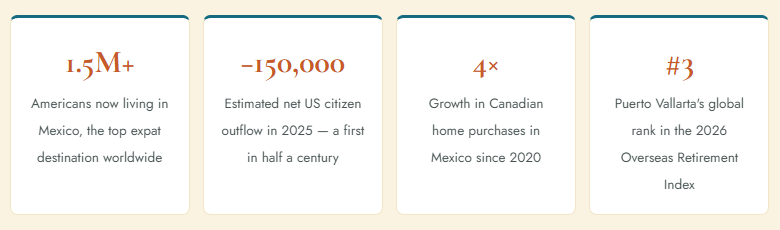
1- 5M+ Americans now living in Mexico, the top expat destination worldwide
−150,000 Estimated net US citizen outflow in 2025 a first in half a century
4X Growth in Canadian home purchases in Mexico since 2020
#3 Puerto Vallarta’s global rank in the 2026 Overseas Retirement Index
Canadians are moving on a parallel but distinct track. Since 2020, the number of Canadian buyers purchasing property in Mexico has quadrupled, concentrated heavily in Puerto Vallarta according to real estate brokers active in the market. A December 2025 survey by Snowbird Advisor found that only about 70% of Canadian snowbirds planned to spend the winter in the United States, down from 82% the year before, with interest in non-US destinations nearly doubling in a single year. Canadian visits to Florida fell 15% year-over-year in the third quarter of 2025, Air Canada, WestJet and Air Transat have all pulled back cross-border routes, and Canadian arrivals to Arizona were down more than 31% in February 2026 compared to the same month two years earlier. Much of that redirected travel and capital is landing in Puerto Vallarta and along the Riviera Nayarit.
“Since 2020 I’ve watched Canadian home purchases in Mexico quadruple and most of it is happening right here in Puerto Vallarta.” paraphrased from real estate brokers active in the Banderas Bay market, as reported by The Globe and Mail, February 2026
2- Why People Are Leaving the US & Canada
The reasons Americans and Canadians give for relocating cluster around a consistent set of pressures on both sides of the border, even though the specifics differ by nationality.
For Americans
Cost of living pressure at home. Housing, healthcare premiums and everyday expenses have outpaced retirement income growth for many households, and cost of living is the single most cited reason Americans give for relocating abroad.
Healthcare costs and Medicare’s limits. Original Medicare generally does not cover care outside the United States, so retirees already budgeting for private coverage are increasingly comparing US premiums to lower-cost private care abroad.
A widening menu of relocation options. More than fifty countries now offer structured visa pathways for retirees and remote workers, and an entire industry of relocation consultants, expat tax specialists, and online communities has matured to support the move.
Political and economic uncertainty. Political climate is cited by a substantial share of Americans who have relocated abroad as a contributing factor in their decision, alongside broader concerns about domestic safety.
For Canadians
A cooling relationship with US travel. Tariff disputes, stricter border-registration requirements for extended stays, and broader unease about crossing into the United States have made a meaningful share of Canadian snowbirds reconsider their usual winter base.
Currency and value. A relatively strong exchange rate against the peso, combined with Mexico’s lower cost structure, means Canadian retirement income and RRSP withdrawals stretch further in Puerto Vallarta than in Florida or Arizona.
Fewer traditional alternatives. Cuba, long a budget winter destination for Canadians, has been disrupted by fuel shortages and sanctions-related airline suspensions, pushing more snowbirds toward Mexico’s Pacific coast instead.
A Florida property market in retreat. Canadians hold an estimated $60 billion in Florida real estate, and with 2026 price declines projected in some Florida markets, a growing number are selling US property and redeploying that capital into Mexican real estate instead.
Read the full breakdown of the case for relocating on our flagship guide, Move Permanently to Mexico and Why, and see how repeat Canadian vacationers weigh the decision in our Canadian Snowbird & Retirement Guide.
3- Why Puerto Vallarta & Riviera Nayarit, Specifically
Mexico has more than a dozen established expat hubs — Lake Chapala, San Miguel de Allende, Mérida, Mazatlán, Mexico City, Oaxaca — but Banderas Bay keeps pulling ahead for the snowbird and retiree demographic specifically, for reasons that are structural rather than trendy:
Global ranking. Puerto Vallarta placed third worldwide in Live and Invest Overseas’ 2026 Overseas Retirement Index, ahead of Portugal’s Algarve and behind only Boquete, Panama and the Algarve region, based on cost of living, healthcare, safety, infrastructure, expat community and residency rules.
Direct flights. Puerto Vallarta’s international airport connects nonstop to dozens of US and Canadian gateway cities year-round, keeping the trip home for holidays, medical follow-ups or grandchildren’s birthdays short and affordable.
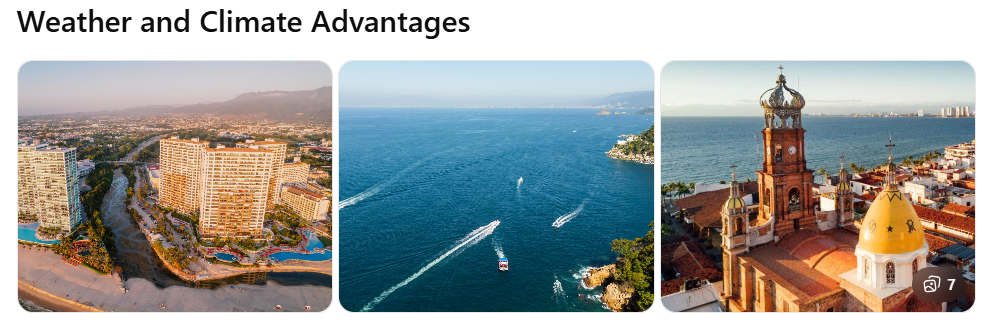
A seasonal community that already exists. Local estimates put winter arrivals of international snowbirds at more than 30,000 in a single season even before the current surge, with more than 70% of Canadian snowbirds staying three months or longer — meaning new arrivals are joining an established social infrastructure, not building one from scratch.
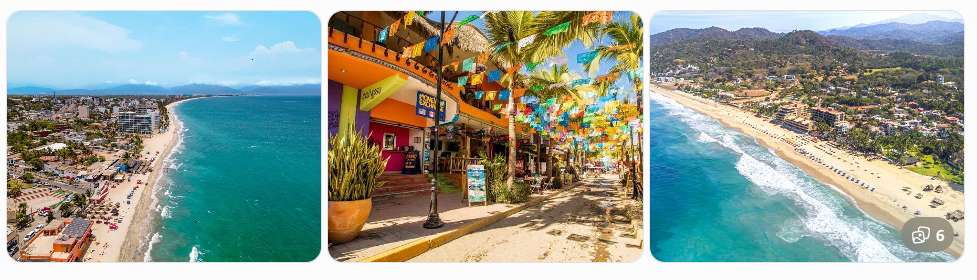
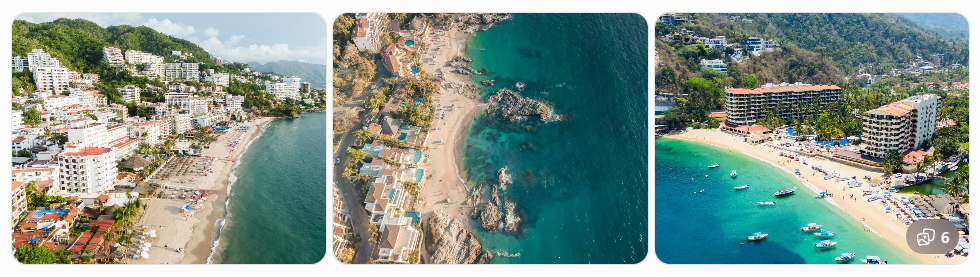
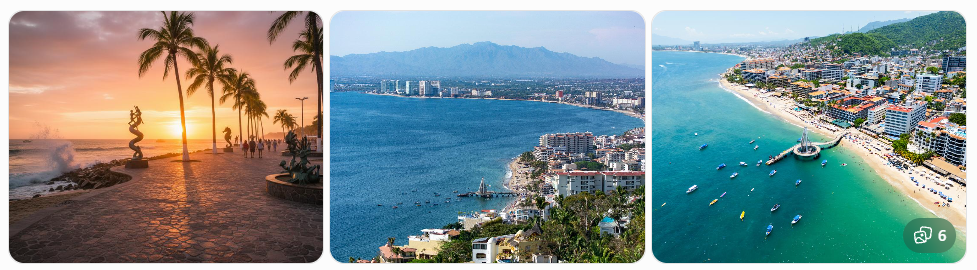
Riviera Nayarit’s range of personalities. From the walkable, nightlife-driven Zona Romántica in Puerto Vallarta to the quieter, family-oriented stretch through Nuevo Nayarit, Bucerias, Punta Mita, Sayulita, San Pancho, Lo de Marcos, Rincon de Guayabitos and San Blas, the bay offers a genuinely different lifestyle every few kilometers along the same coastline.
Medical tourism infrastructure. Beyond routine care, Puerto Vallarta has become a major hub for dental and other medical tourism, with industry reports projecting more than 250,000 Canadians will travel to Mexico for dental care alone in 2026, much of it concentrated in Puerto Vallarta’s clinics.
4- Cost of Living, Side by Side
The dollar-and-cents comparison is where the migration decision usually gets made. Independent retirement indexes put a comfortable monthly budget in Puerto Vallarta at roughly $3,305 USD, compared to a US Bureau of Labor Statistics average monthly spend of $5,119 for American retirees aged 65 and older — a gap of more than a third. On a broader affordability index, Mexico scores as “affordable” against Canada’s “expensive” rating, translating into a difference of roughly $1,450 USD per month, or over $17,000 per year, for a single retiree.
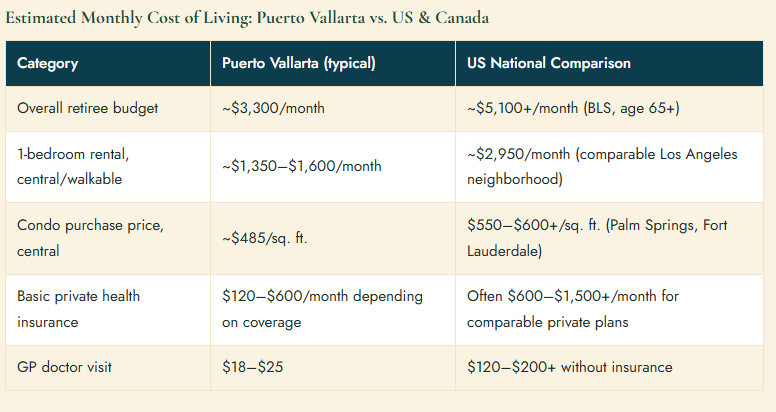
Estimated Monthly Cost of Living: Puerto Vallarta vs. US & Canada
Category Puerto Vallarta (typical) US National Comparison
Overall retiree budget ~$3,300/month ~$5,100+/month (BLS, age 65+)
1-bedroom rental, central/walkable ~$1,350–$1,600/month ~$2,950/month (comparable Los Angeles neighborhood)
Condo purchase price, central ~$485/sq. ft. $550–$600+/sq. ft. (Palm Springs, Fort Lauderdale)
Basic private health insurance $120–$600/month depending on coverage Often $600–$1,500+/month for comparable private plans
GP doctor visit $18–$25 $120–$200+ without insurance
Grocery, dining and everyday cost comparisons including item-by-item Numbeo pricing — are broken down in detail in our Puerto Vallarta Food Costs vs. USA & Canada guide, and the household side of the equation is covered in the Snowbirds Long-Term Condo Rentals Planning guide for anyone renting before they buy.
5- Real Estate Market Snapshot 2026
The cost-of-living gap is only part of what is drawing capital south. Puerto Vallarta and Banderas Bay real estate closed 2025 with $773.4 million in combined residential sales volume, a 28% year-over-year increase, on 1,454 total units sold up from 1,203 the year before. That growth has carried into 2026: May market reports show a median condo sale price in the $412,500 to $428,219 range, up roughly 30% year-over-year, with house prices up more than 33% over the same period and active house listings expanding by more than 21%.
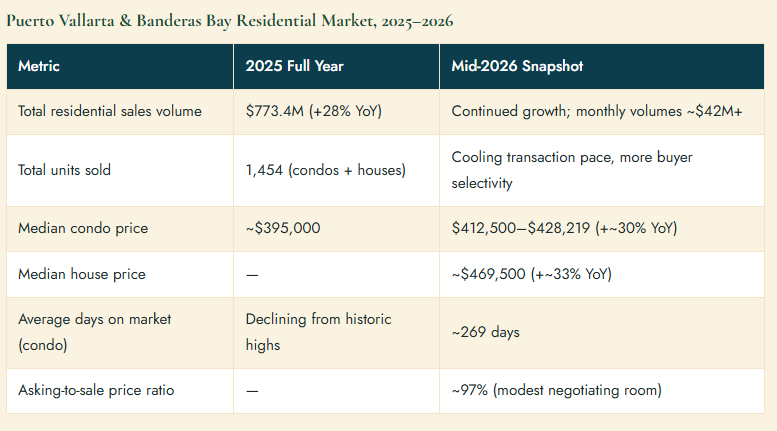
Puerto Vallarta & Banderas Bay Residential Market, 2025–2026
Metric 2025 Full Year Mid-2026 Snapshot
Total residential sales volume $773.4M (+28% YoY) Continued growth; monthly volumes ~$42M+
Total units sold 1,454 (condos + houses) Cooling transaction pace, more buyer selectivity
Median condo price ~$395,000 $412,500–$428,219 (+~30% YoY)
Median house price ~$469,500 (+~33% YoY)
Average days on market (condo) Declining from historic highs ~269 days
Asking-to-sale price ratio ~97% (modest negotiating room)
What this means for a prospective buyer: the frantic seller’s market of 2021 through early 2024 when properties routinely moved in 60 to 90 days, at or above asking price has given way to a more balanced buyer’s market since mid-2025. Prices are still appreciating on a rolling annual basis, but inventory has expanded and negotiating leverage has shifted back toward buyers, particularly in the $1 million to $1.5 million house segment, where year-to-date sales are up more than 44%.
Foreign ownership works through Mexico’s fideicomiso, a bank trust structure required for property within the restricted coastal zone, which both US and Canadian citizens have used safely in the region for more than five decades. The mechanics, closing costs, and step-by-step process are covered in full in our Buying Real Estate Guide Puerto Vallarta 2026 and the Real Estate in the Banderas Bay FAQs by AMPI, sourced directly from the Mexican Association of Real Estate Professionals.
Thinking About Buying in Banderas Bay?
See current listings, neighborhood-by-neighborhood pricing, and the full foreign-buyer process before you commit.

6- Healthcare: Quality & Cost
Healthcare is consistently named among the top reasons Americans and Canadians choose to relocate, and Puerto Vallarta’s private medical sector is a major part of the draw. Private specialist consultations typically run $40 to $200, a knee surgery that might cost many multiples of that in the US or Canada runs closer to $1,580 in Mexico’s private sector, and physical therapy costs 50% to 80% less than comparable US care according to expat insurance data.
Healthcare Cost Comparison for Expats & Retirees
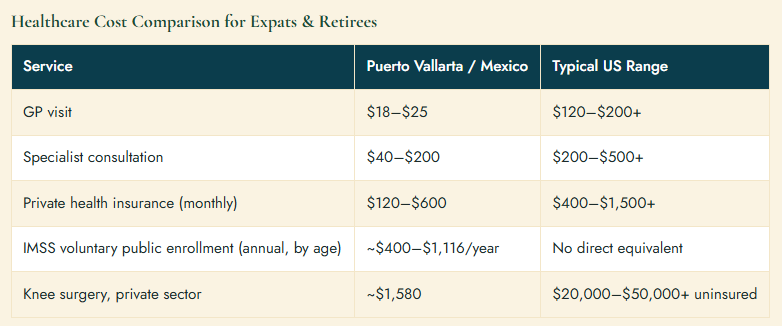
Service Puerto Vallarta / Mexico Typical US Range
GP visit $18–$25 $120–$200+
Specialist consultation $40–$200 $200–$500+
Private health insurance (monthly) $120–$600 $400–$1,500+
IMSS voluntary public enrollment (annual, by age) ~$400–$1,116/year No direct equivalent
Knee surgery, private sector ~$1,580 $20,000–$50,000+ uninsured
One important caveat for Americans: Original Medicare generally does not pay for care outside the United States, so most retirees who relocate keep Part B active as a safety net for care back home while budgeting separately for private coverage or the public IMSS system in Mexico. Canadians typically maintain provincial coverage requirements around days spent outside the country while layering on private travel or expat medical insurance. Full local options, including English-speaking providers and hospital networks, are covered on our Health hub.

7- Visas & Residency in 2026
Most Americans and Canadians relocating to Puerto Vallarta or the Riviera Nayarit apply for the Residente Temporal (Temporary Resident Visa), which permits a stay of more than 180 days and up to four years, with the option to renew or later convert to Permanent Residency. Since mid-2025, Mexican consulates have based the financial qualification thresholds on Mexico’s UMA index rather than the old minimum-wage calculation, and 2026 brought a significant increase in government processing fees alongside the updated income figures.
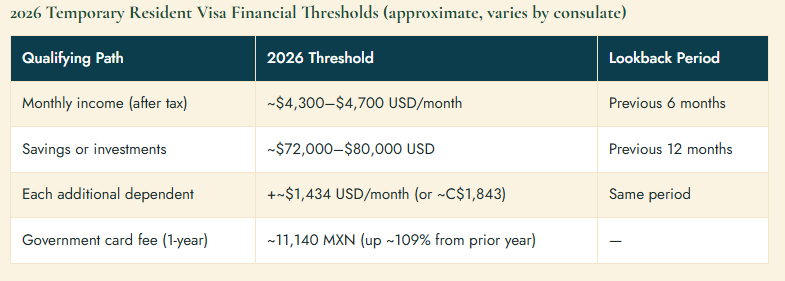
2026 Temporary Resident Visa Financial Thresholds (approximate, varies by consulate)
Qualifying Path 2026 Threshold Lookback Period
Monthly income (after tax) ~$4,300–$4,700 USD/month Previous 6 months
Savings or investments $72,000–$80,000 USD Previous 12 months$1,434 USD/month (or ~C$1,843) Same period
Each additional dependent +
Government card fee (1-year) ~11,140 MXN (up ~109% from prior year) —
The process runs in two steps: applying at a Mexican consulate in the US or Canada before departure, then activating residency status with Mexico’s immigration authority (INM) after arrival. After four consecutive years holding Temporary Resident status, most applicants become eligible for Permanent Residency, which removes the ongoing income test entirely and never expires. Exact thresholds vary meaningfully by consulate, so confirming current figures with the specific consulate of jurisdiction before applying is essential a step our Move Permanently to Mexico guide walks through in more depth.
8- A Candid Look at Safety
No honest relocation guide skips this topic. In February 2026, a period of unrest in Puerto Vallarta briefly unsettled parts of the long-running snowbird community, and flights and travel advisories were affected for a short period before normal operations resumed. Industry voices, including the president of Snowbird Advisor, acknowledged that the episode shook confidence in a destination with an otherwise decades-long track record as a safe, stable winter base for tens of thousands of Canadian and American retirees.
The broader pattern remains one of continuity rather than disruption: condominium buildings in Puerto Vallarta with residents who have wintered there for thirty or forty consecutive years, a real estate market still posting double-digit annual growth in 2026, and Canadian home-buying activity that has quadrupled since 2020 rather than contracted. That said, prospective movers should always check current government travel advisories, talk to residents already living in the specific neighborhood they are considering, and treat any single incident as one data point within a much longer track record rather than the full picture.
9- Where to Land: Town by Town
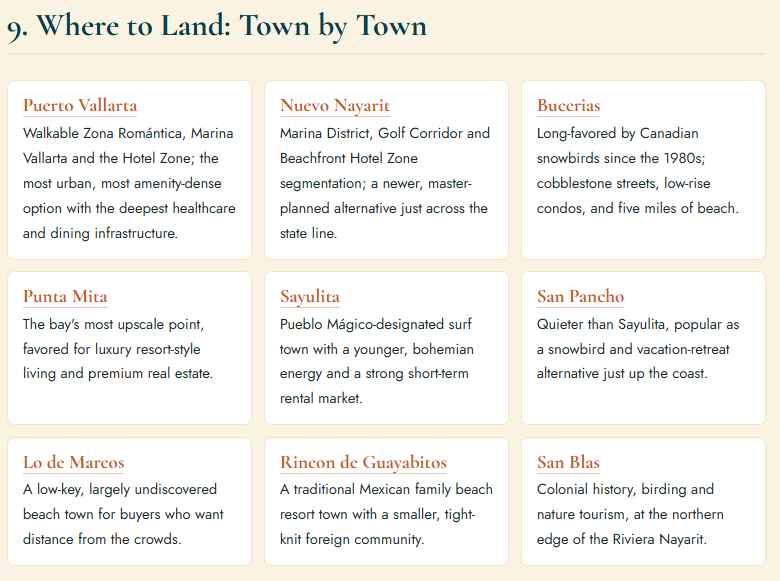
Puerto Vallarta
Walkable Zona Romántica, Marina Vallarta and the Hotel Zone; the most urban, most amenity-dense option with the deepest healthcare and dining infrastructure.
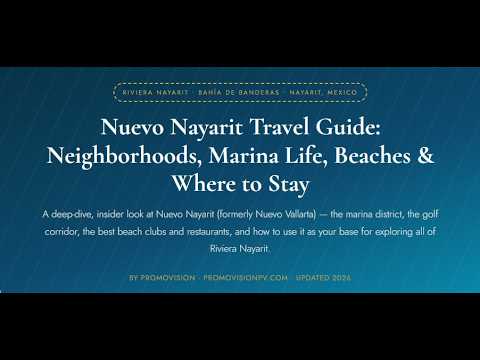
Nuevo Nayarit
Marina District, Golf Corridor and Beachfront Hotel Zone segmentation; a newer, master-planned alternative just across the state line.
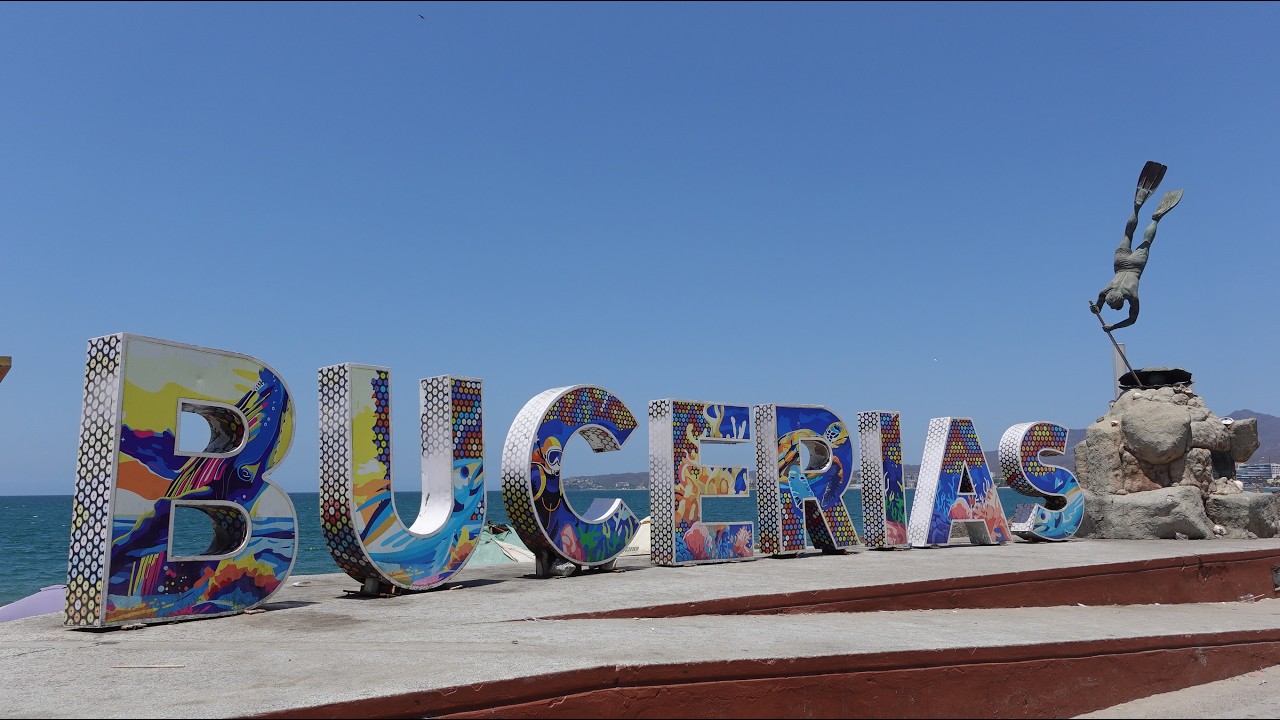
Bucerias
Long-favored by Canadian snowbirds since the 1980s; cobblestone streets, low-rise condos, and five miles of beach.
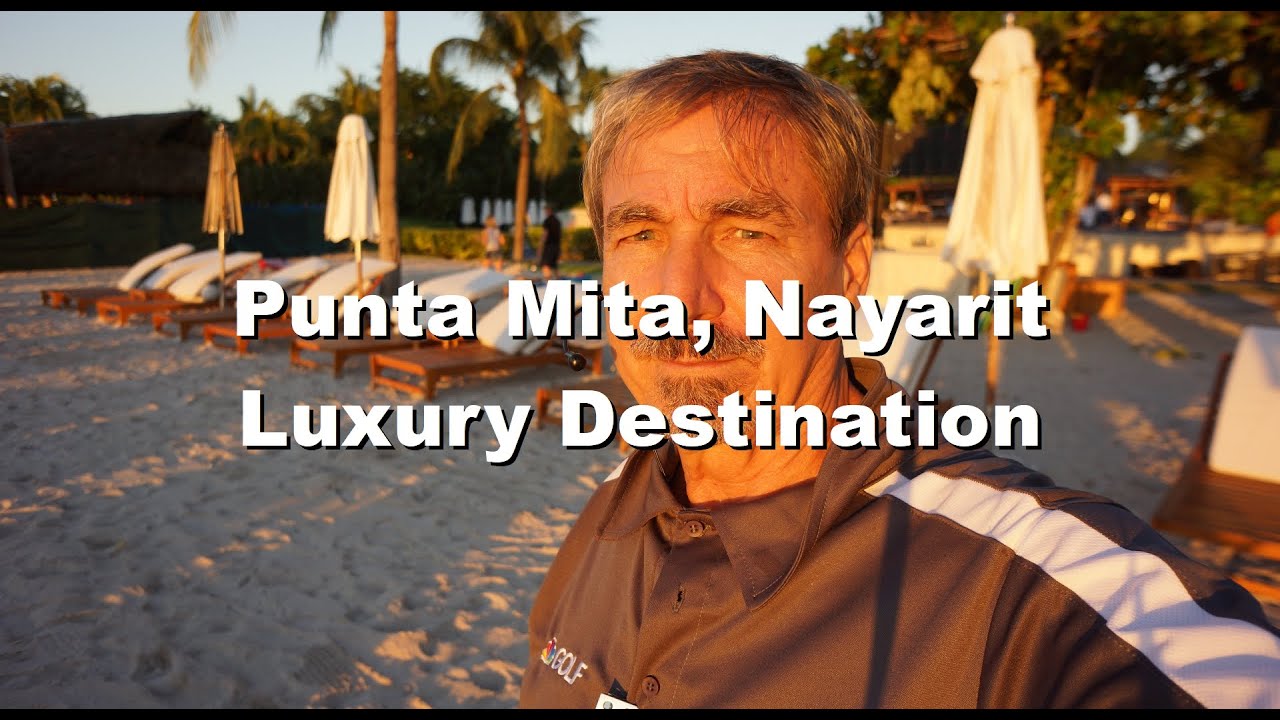
Punta Mita
The bay’s most upscale point, favored for luxury resort-style living and premium real estate.
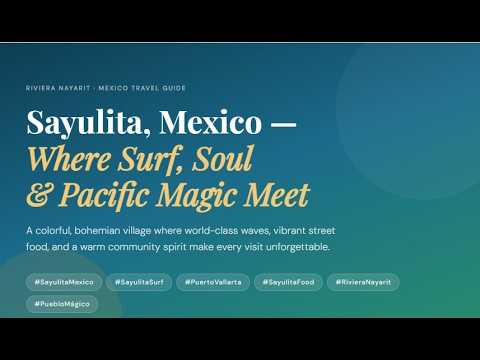
Sayulita
Pueblo Mágico-designated surf town with a younger, bohemian energy and a strong short-term rental market.
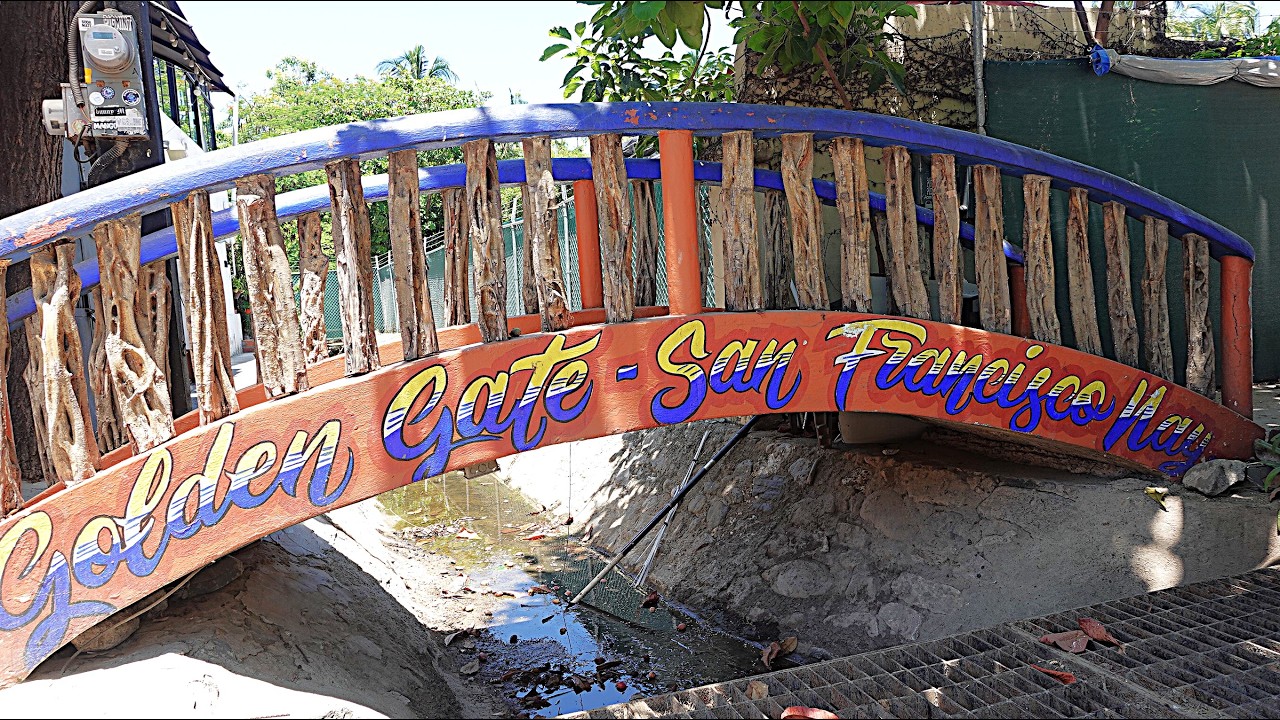
San Pancho
Quieter than Sayulita, popular as a snowbird and vacation-retreat alternative just up the coast.
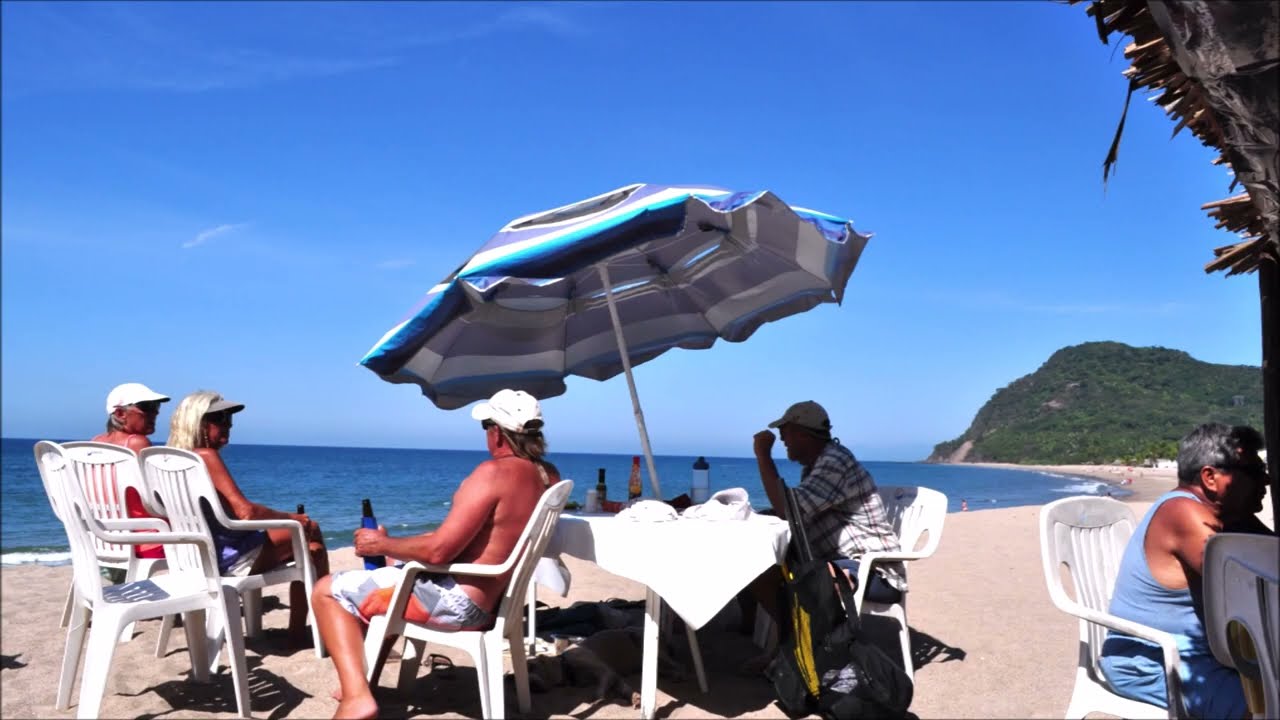
Lo de Marcos
A low-key, largely undiscovered beach town for buyers who want distance from the crowds.
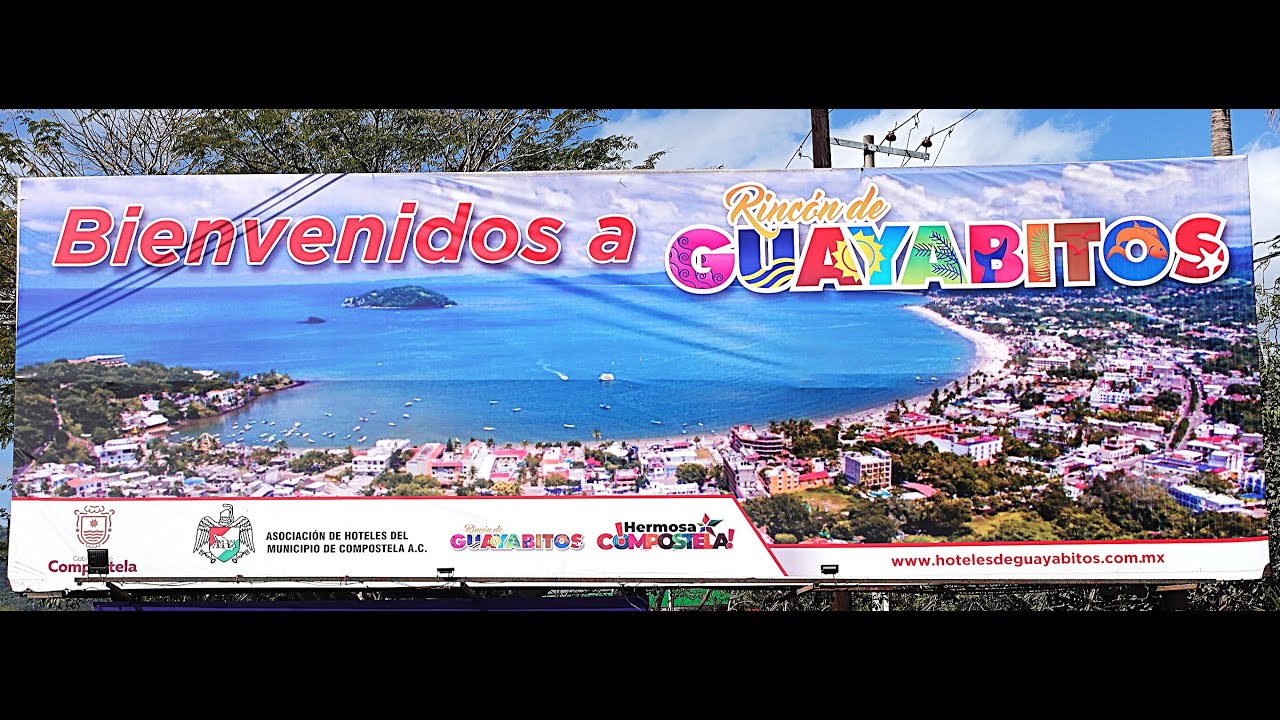
Rincon de Guayabitos
A traditional Mexican family beach resort town with a smaller, tight-knit foreign community.
San Blas
Colonial history, birding and nature tourism, at the northern edge of the Riviera Nayarit.
For a deeper location-selection framework, see Real Estate Pros & Cons Puerto Vallarta, which weighs neighborhood trade-offs specifically from a buyer’s perspective, and our Puerto Vallarta Second Home Trend 2026 report.
10- Real Estate Buyer’s Guide: Puerto Vallarta & Riviera Nayarit
For readers whose interest in this migration story is specifically about buying, here is the condensed version of the process that our fuller guides cover in depth:
Rent through a full calendar year first, including the summer rainy season, before committing to a purchase a neighborhood that feels perfect in January can feel very different in August.
Work with a bilingual, AMPI-affiliated real estate professional and an independent Mexican attorney never rely solely on the seller’s representative.
Understand the fideicomiso structure before signing anything; it is a bank trust, not a lease, and grants full beneficial ownership rights within the restricted coastal zone.
Budget for closing costs separately from the purchase price, typically in the range of 5% to 8% of the transaction value, covering notary fees, trust setup, acquisition tax and registration.
Confirm HOA fees, rental potential and building quality if the property is a condo these vary enormously between Centro, the Hotel Zone, Marina Vallarta and the Riviera Nayarit towns.
Time the visa and the purchase together if you plan to reside full-time owning property does not by itself guarantee residency approval, though it can support certain applications.
The full legal and investment framing, including AMPI’s official fideicomiso FAQs, is covered in About Buying Real Estate in Puerto Vallarta and Own a Property, Need a Property Management for anyone planning to rent out a purchase seasonally.
11- Getting Found: Visibility on Google, Bing, Yahoo, Facebook & Instagram
This migration is also a business opportunity for real estate agents, property managers, relocation consultants and tourism businesses serving the incoming wave of American and Canadian buyers. Ranking for this audience’s search behavior requires deliberate, ongoing work across search engines and social platforms, not a one-time listing.
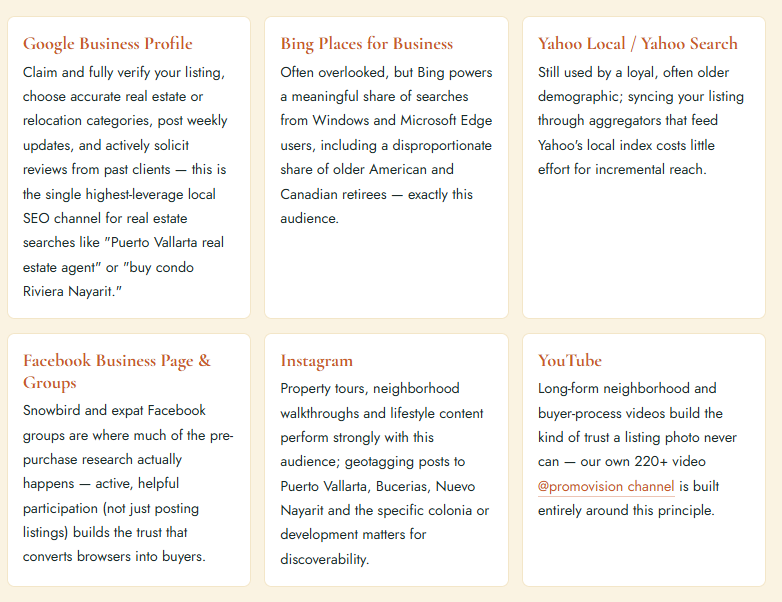
Google Business Profile
Claim and fully verify your listing, choose accurate real estate or relocation categories, post weekly updates, and actively solicit reviews from past clients, this is the single highest-leverage local SEO channel for real estate searches like “Puerto Vallarta real estate agent” or “buy condo Riviera Nayarit.”
Bing Places for Business
Often overlooked, but Bing powers a meaningful share of searches from Windows and Microsoft Edge users, including a disproportionate share of older American and Canadian retirees exactly this audience.
Yahoo Local / Yahoo Search
Still used by a loyal, often older demographic; syncing your listing through aggregators that feed Yahoo’s local index costs little effort for incremental reach.
Facebook Business Page & Groups
Snowbird and expat Facebook groups are where much of the pre-purchase research actually happens active, helpful participation (not just posting listings) builds the trust that converts browsers into buyers.
Instagram
Property tours, neighborhood walkthroughs and lifestyle content perform strongly with this audience; geotagging posts to Puerto Vallarta, Bucerias, Nuevo Nayarit and the specific colonia or development matters for discoverability.
YouTube
Long-form neighborhood and buyer-process videos build the kind of trust a listing photo never can our own 220+ video @promovision channel is built entirely around this principle.
Consistent name-address-phone data across every platform, structured data (schema markup) on your website, and content that answers the specific questions this audience is searching visa costs, fideicomiso basics, cost-of-living comparisons are what separate listings that rank from listings that don’t. Businesses in the region can also list directly with PromovisionPV; see Promote Your Tourism Business on PromovisionPV.
12- Frequently Asked Questions
Why are so many Americans and Canadians moving to Mexico in 2026? The leading drivers are cost of living, healthcare costs, safety concerns and political or economic uncertainty at home, combined with Mexico’s proximity, climate, established expat infrastructure and a favorable exchange rate. Cost of living is the single most cited factor among Americans who have already relocated abroad. Canadian snowbirds are separately shifting away from traditional US winter destinations amid cooling cross-border travel sentiment and rising costs in Florida and Arizona.
How much does it cost to live in Puerto Vallarta compared to the US or Canada? Independent retirement indexes place a comfortable monthly budget in Puerto Vallarta at roughly $3,300 USD, compared to an average monthly spend of just over $5,100 for American retirees aged 65 and older, per US Bureau of Labor Statistics data. Housing, groceries, dining out, domestic help and routine healthcare are where the gap is widest.
What visa do Americans and Canadians need to move to Mexico long-term? Most retirees and remote workers apply for the Residente Temporal (Temporary Resident Visa), allowing a stay of six months up to four years. Applicants qualify through monthly income over the prior six months or savings held over the prior twelve months, with thresholds set annually by each consulate. After four consecutive years as a temporary resident, most people can convert to Permanent Residency, which has no expiration and no ongoing income test.
Is Puerto Vallarta safe for American and Canadian retirees in 2026? Puerto Vallarta and the Riviera Nayarit remain among the most visited and most established expat regions in Mexico, with decades of continuous snowbird and retiree residence. Isolated incidents can occur and are worth following through official advisories, but the long-running pattern is a large, stable seasonal and year-round foreign community that returns year after year. Always check current government travel advisories and speak with local expats before finalizing a relocation decision.
Can Americans and Canadians legally own real estate in Puerto Vallarta and the Riviera Nayarit? Yes. Because the region falls within Mexico’s restricted coastal zone, foreign buyers hold title through a fideicomiso, a bank trust administered by a Mexican financial institution, in which the buyer retains full beneficial rights to use, rent, sell or bequeath the property. This structure has been used safely by foreign buyers for decades.
Where are real estate prices heading in Puerto Vallarta in 2026? Mid-2026 market reports show median condo prices in the $400,000 to $430,000 range, up significantly year-over-year, even as transaction counts have cooled from the 2021–2024 peak — giving buyers more negotiating room and inventory than in recent years. House prices have shown similar double-digit annual appreciation, with expanding inventory in the $1 million to $1.5 million segment.
This article synthesizes publicly available migration, real estate, visa and healthcare data current as of September 2026. Visa income thresholds, government fees and real estate prices change frequently and vary by consulate and by month — always confirm current figures directly with the relevant Mexican consulate, INM, or a licensed AMPI real estate professional before making a decision.
Plan Your Move to Puerto Vallarta & the Riviera Nayarit
Explore neighborhoods, real estate listings, visa steps and 420+ video guides from a local team with 25+ years on the ground.

External authority resources referenced in this guide:
AMPI — Asociación Mexicana de Profesionales Inmobiliarios
Riviera Nayarit Convention & Visitors Bureau
VisitMexico — Official Tourism Board
INM — Instituto Nacional de Migración
SRE — Secretaría de Relaciones Exteriores
US Department of State — Travel Advisories
Related PromovisionPV guides:
Move Permanently in Mexico and Why Guide
Real Estate & Relocation Guide Puerto Vallarta
Puerto Vallarta Second Home Trend 2026
Snowbirds Long-Term Condo Rentals Planning
Puerto Vallarta Food Costs vs. USA & Canada
Real Estate Pros & Cons Puerto Vallarta
Buying Real Estate Guide Puerto Vallarta 2026
Real Estate in the Banderas Bay FAQs by AMPI
Canadian Snowbird & Retirement Guide
© PromovisionPV — Puerto Vallarta & Riviera Nayarit Travel Guide. Travel Blogger, Travel Vlogger, Video Productions, Tourism Mexico.