
Historic Gringo Gulch Neighborhood Puerto Vallarta. Perched on a sunlit hillside above the cobblestones of downtown Puerto Vallarta, with bougainvilla spilling over whitewashed walls and the great arc of Banderas Bay glittering below, lies Gringo Gulch, the neighborhood that changed Mexico’s tourism history forever. This is where director John Huston brought Hollywood to the tropics, where Elizabeth Taylor and Richard Burton ignited one of the most celebrated love affairs of the 20th century, and where a quiet fishing village woke up to find itself on the front page of every newspaper in the world.
01 · Origins
The Birth of a Legendary Enclave
Long before the boutique hotels, the rooftop bars, and the cruise ships anchored in Banderas Bay, Puerto Vallarta was something far more precious: a secret. Tucked between the Sierra Madre mountains and the Pacific coast of Jalisco, the town was accessible only by sea or by a gruelling dirt road from Guadalajara, a journey that took a day and a half. Letters to the United States took a month to arrive. Telephones were a rumor. This magical isolation was, for the handful of American and Canadian expatriates who discovered it in the early 1950s, precisely the point.
Following the city’s centenary celebrations in 1951, word quietly spread through artistic and intellectual circles about a small paradise on the Pacific. The first significant wave of foreigners painters, writers, adventurers, and architects — began climbing the steep hillside above the Río Cuale, where the land offered something rare: sweeping views of the bay to the west, and cool breezes that made the tropical heat bearable. They called the area El Cerro. The world would eventually call it Gringo Gulch.
Name Origin
The name “Gringo Gulch” blends two vivid terms: gringo, the colloquial Mexican-Spanish term for North American foreigners, and gulch, the English word for a narrow ravine or canyon. The neighborhood’s southern end dips toward the Río Cuale, creating a natural topographic gully that gave the second half of its name. It was Elizabeth Taylor herself who first popularized the nickname, using it affectionately to describe her adopted neighborhood at a time when the term carried none of its later edge.
The “Gulch” portion of the name refers to the dip toward the river at the neighborhood’s southern end, a topographic quirk that offered the earliest settlers views to the south over Banderas Bay, making it the most coveted hillside real estate in all of Vallarta. At the time, it was the only hill accessible enough for construction, and those who built there understood they were staking a claim on something extraordinary.
02 · The Catalyst
John Huston and “The Night of the Iguana”
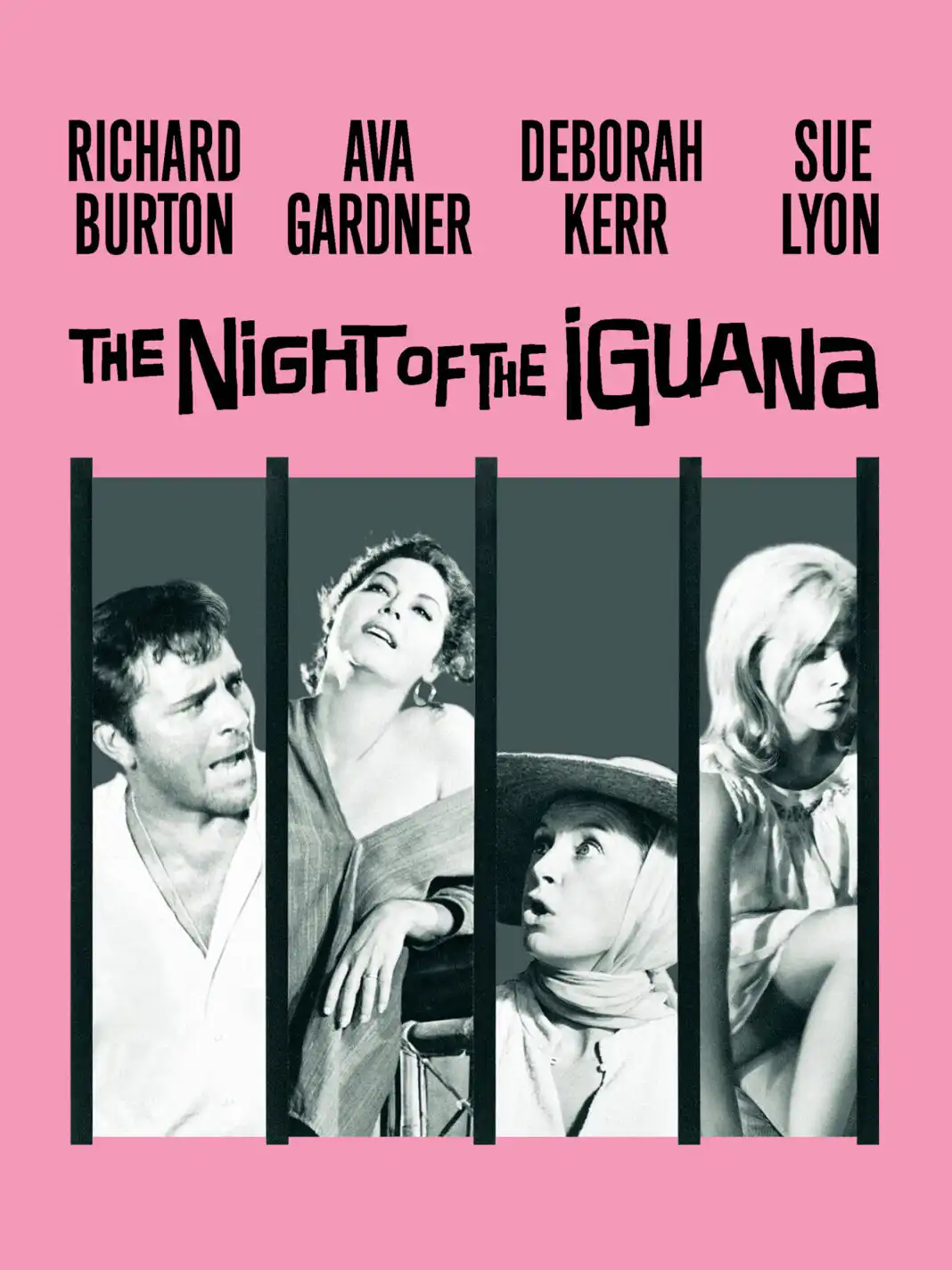
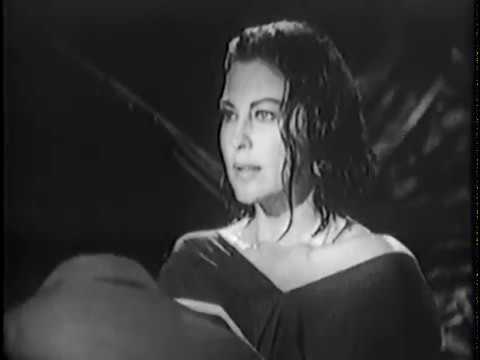
John Huston. the legendary director of The Maltese Falcon, The African Queen, and The Treasure of the Sierra Madre loved Mexico the way Ernest Hemingway loved Cuba. It was where he felt most alive. As one writer of the era put it: “John was to film what Hemingway was to words and Mexico was where both of them felt most at home.” Huston had a long, deeply personal relationship with the country, and when he selected an isolated cove called Mismaloya, eight miles south of Puerto Vallarta, as the location for his 1963 film adaptation of Tennessee Williams’ The Night of the Iguana, he was not simply choosing a backdrop. He was choosing a destiny for himself, for his cast, and for the town that would be forever changed.
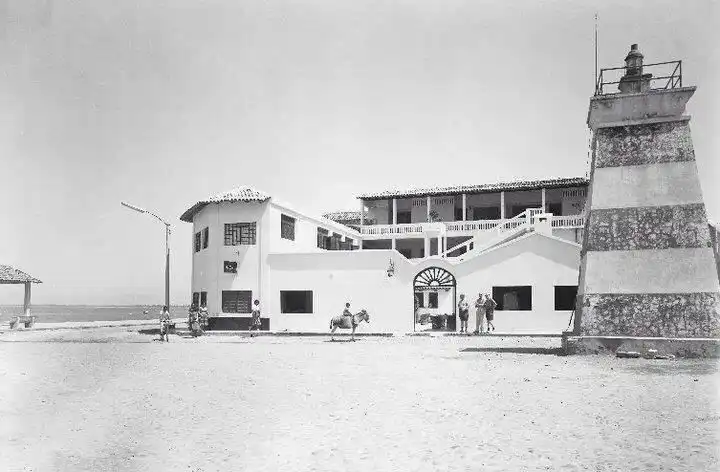
It was Guillermo Wulff, a Mexico City engineer who had obtained a 90-year land lease on the Mismaloya cove, who first convinced Huston to shoot there. There were no facilities at Mismaloya, no roads, no hotels, no infrastructure of any kind. Cast and crew would stay in Puerto Vallarta and travel to set by boat each day. The production headquarters was set up at the old Hotel Oceano, a modest establishment near the black-and-white striped lighthouse on the Malecón promenade in Old Town.
Mismaloya Cove. Filming Location, “The Night of the Iguana” (1963)
Photo location: Mismaloya, 8 miles south of Puerto Vallarta, Jalisco · © Insert photographer credit
The cast that Huston assembled in that remote corner of Mexico was itself extraordinary: Richard Burton, Ava Gardner, Deborah Kerr, and Sue Lyon. Elizabeth Taylor was not in the film, but she arrived anyway, famously, scandalously, and with a retinue of journalists not far behind. When Taylor discovered the conditions of the hotel Huston had booked for himself and the couple, the story goes that Burton called his friend and director and said: “My friend, if we don’t find suitable accommodations for Elizabeth, I’m afraid I won’t be able to star in your film.”
Without hesitation, Huston offered the couple his own rented villa on the hillside of Gringo Gulch, a place called Casa Kimberley. The rest, as they say, is history.
Huston’s own love affair with Puerto Vallarta never wavered. He donated land, money, and equipment to the local community, supported the preservation of its culture, and became one of the city’s most celebrated adopted sons. His legacy is woven into the very fabric of Gringo Gulch and the Vallarta that exists today.
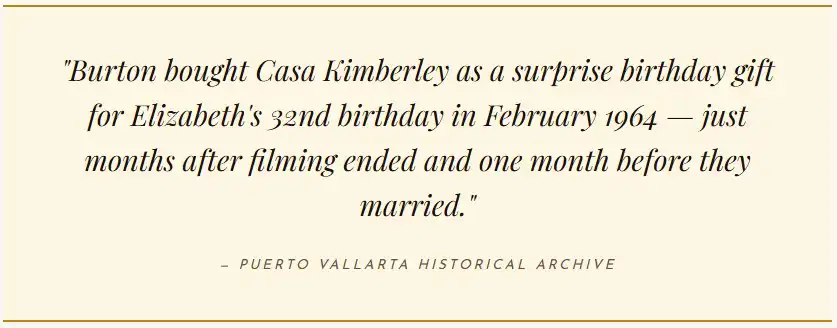
“Burton bought Casa Kimberley as a surprise birthday gift for Elizabeth’s 32nd birthday in February 1964, just months after filming ended and one month before they married.”
Puerto Vallarta Historical Archive
03 · The Romance
Elizabeth Taylor, Richard Burton & Casa Kimberley
Elizabeth Taylor and Richard Burton had already begun their incandescent, world-devouring affair in 1963 on the set of Cleopatra. When Burton brought her to Puerto Vallarta for the filming of The Night of the Iguana, the global press followed. Paparazzi camped in the cobblestone streets. Gossip columnists filed daily dispatches. And Puerto Vallarta — population approximately 10,000, no television, no phone lines to speak of — suddenly found itself the most talked-about place on earth.
The couple fell completely and irrevocably in love with Casa Kimberley and with Puerto Vallarta itself. In a gesture of extraordinary romance, Burton purchased the nine-bedroom villa for $57,000 as a surprise birthday gift for Taylor’s 32nd birthday in February 1964, just months after filming wrapped and a single month before their first marriage.
The Lover’s Arch — A Bridge Between Two Hearts
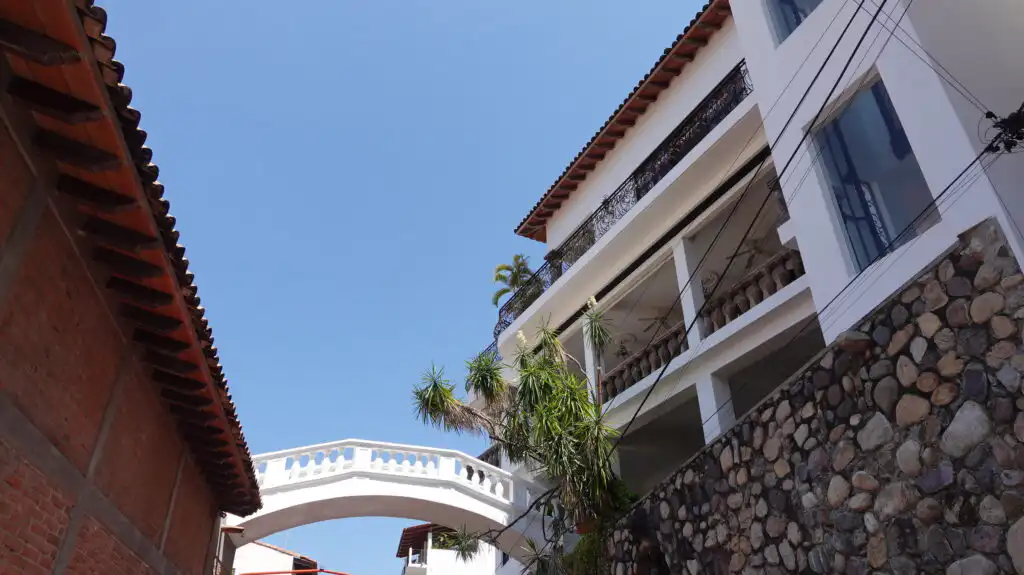
As their lives in Gringo Gulch deepened, Burton also purchased the villa directly across the narrow street from Casa Kimberley. The two properties were then connected by what became one of Puerto Vallarta’s most photographed and storied structures: a pink arched footbridge, built by architect Guillermo Wulff, that spanned the cobblestone lane below. According to neighborhood legend, the bridge ended at a door that opened directly into Elizabeth’s bedroom, and Burton would cross each evening to read Shakespeare aloud to her. It became known, inevitably, as the Lover’s Arch or the Bridge of Love, and it remains one of the defining images of Gringo Gulch to this day.
Casa Kimberley Today
After years as a bed-and-breakfast and museum celebrating the Taylor-Burton legacy, Casa Kimberley is today a luxury boutique hotel. Guests can stay in rooms where Hollywood royalty once slept, sip cocktails on the terrace with its extraordinary views over Banderas Bay, and walk the very bridge that once connected two of cinema’s greatest stars. The famous pink Lover’s Arch still stands. Visit: casakimberley.com
Taylor and Burton’s relationship was as turbulent as it was passionate. They married in 1964, divorced in 1974, remarried in 1975, and divorced again in 1976. Through it all, Puerto Vallarta and Gringo Gulch remained a constant, a place where, by all accounts, they were genuinely happy. Neighbors recall that Elizabeth, despite her global fame, became a true part of the community: shopping at local markets, learning the names of local families, attending church at Our Lady of Guadalupe, whose ornate tower looms just below the neighborhood. When the couple was involved in a jeep accident on the cobblestones nearby, the entire community held its breath until word came that they were safe.
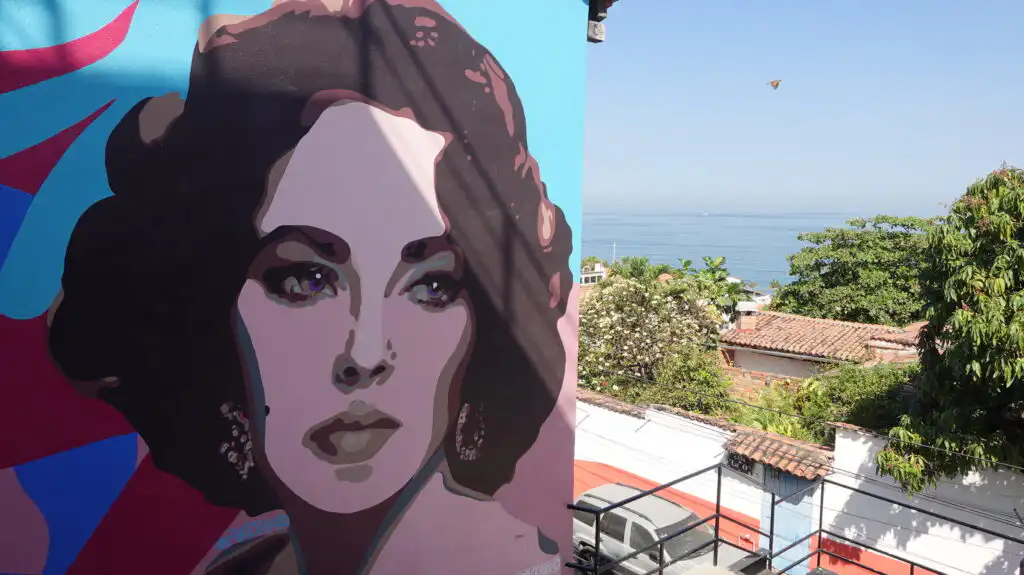
When Richard Burton died in 1984, Elizabeth Taylor found it too painful to return to Puerto Vallarta. She sold Casa Kimberley, along with nearly everything inside it, the clothes, the furniture, the letters. The local community, which had genuinely loved her, mourned the departure as a kind of ending. But the legend she and Burton had created and the international spotlight they had shone on this corner of Mexico could never be taken away.
04 · The Jet Set
Hollywood Royalty in the Gulch
The presence of John Huston, Elizabeth Taylor, and Richard Burton in Puerto Vallarta acted as an irresistible magnet for the Hollywood elite. Through the 1960s and 1970s, Gringo Gulch became an informal gathering place for the most celebrated names in international film, television, and culture. Friends visited, then stayed. Visitors bought villas. The hillside that had once been home only to a handful of adventurous expatriates became, for a glittering season, one of the most star-studded addresses on the planet.
Popular people frequent visitors or residents
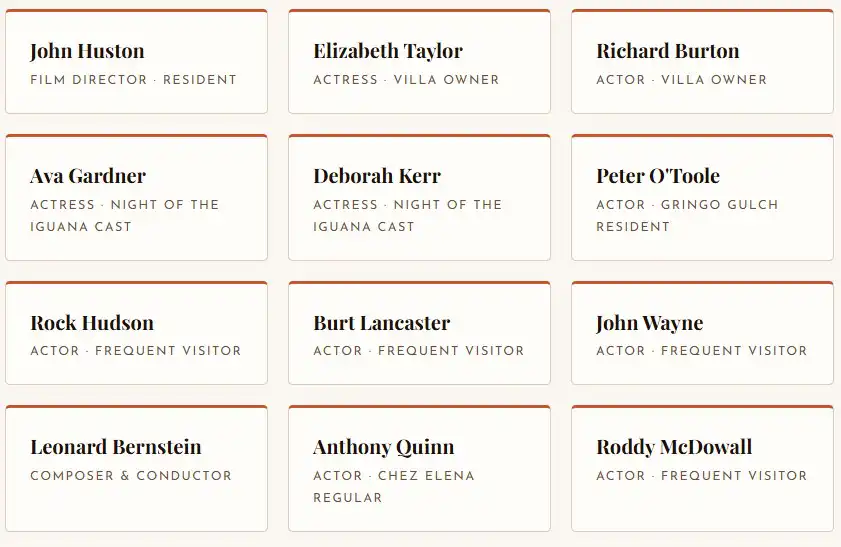
The legendary Chez Elena restaurant, situated on a cobblestoned Gringo Gulch street, became the unofficial dining room of this starry community. Peter O’Toole, Elizabeth Taylor, Richard Burton, Anthony Quinn, and Robert Shaw were all known to frequent its tables. The restaurant embodied the unique, serendipitous social world that had formed on this hillside, a world where Hollywood glamour and Mexican village life had somehow, magnificently, merged.
Award-winning CBS news broadcaster Charles Collingwood also kept a home in Gringo Gulch, adding an international media dimension to the neighborhood’s cultural richness. The community was never simply a celebrity enclave — it was also a genuine gathering of creative minds from across the English-speaking world, drawn together by the beauty of Banderas Bay and the irresistible charm of old Vallarta.
05 · Architecture
Estilo Vallarta — A Style Born on These Hills
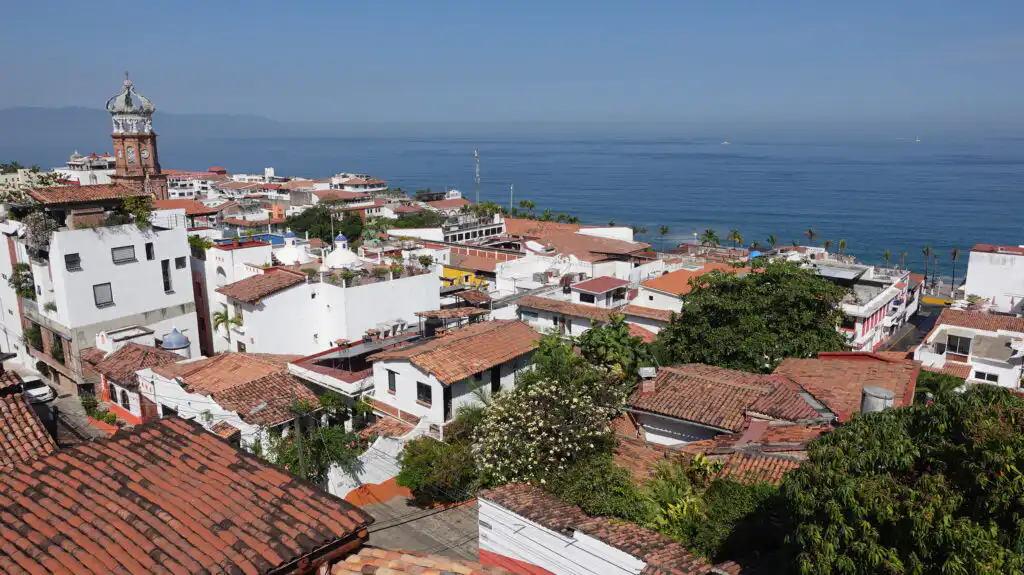
Gringo Gulch is not merely a piece of social history — it is one of the most architecturally coherent and visually captivating urban landscapes in all of Mexico. The neighborhood’s distinctive look owes a profound debt to one man: architect Fernando “Freddy” Romero, who arrived in Puerto Vallarta in 1952 and spent decades creating what would become known as Estilo Vallarta — a hybrid architectural language that married colonial Mexican tradition with modern tropical sensibility.
Romero’s genius lay in his understanding of place. He built with local materials: adobe bricks, hand-painted talavera tiles, hand-carved wooden beams, and the abundant volcanic stone of the Sierra Madre. His villas were designed to breathe with the landscape — to frame views, capture breezes, and allow the jungle to press inward through open courtyards planted with palms and bougainvillea. He designed emblematic estates on Calles Matamoros, Mina, Galeana, Cuauhtémoc, and Miramar, and his imprint on the Las Campanas complex remains his most celebrated civic achievement.
“He could discern the architectural essence of the town and metamorphose it into homes that paid homage to the environment and the local forms.”
Local historian, on Fernando “Freddy” Romero
Walking through Gringo Gulch today is to walk through Romero’s vision made real. The defining elements of Estilo Vallarta are immediately recognizable:
Red-tiled rooftops, low-pitched terracotta tiles that catch the golden light of afternoon
Whitewashed stucco facades, brilliantly reflective in the tropical sun, punctuated by vivid color at doors and window frames
Wrought-iron balconies, hand-forged grillwork laden with cascading bougainvillea in magenta, orange, and scarlet
Open interior courtyards, hidden paradises of fountains, tropical planting, and hand-laid tile
Cobblestone streets and stone staircases, irregular, ancient-looking, and utterly photogenic
Panoramic terraces, every home oriented toward the bay, toward the mountains, toward the sky
Guillermo Wulff and Luis Favela Icaza contributed structural engineering expertise that made it possible to build on the steep hillside terrain, adding water tanks, pumps, and pathways that gave the neighborhood the infrastructure it needed to grow. Together, these men created a physical environment of uncommon beauty — one that has been recognized as a defining expression of Mexican vernacular architecture adapted for the Pacific tropics.
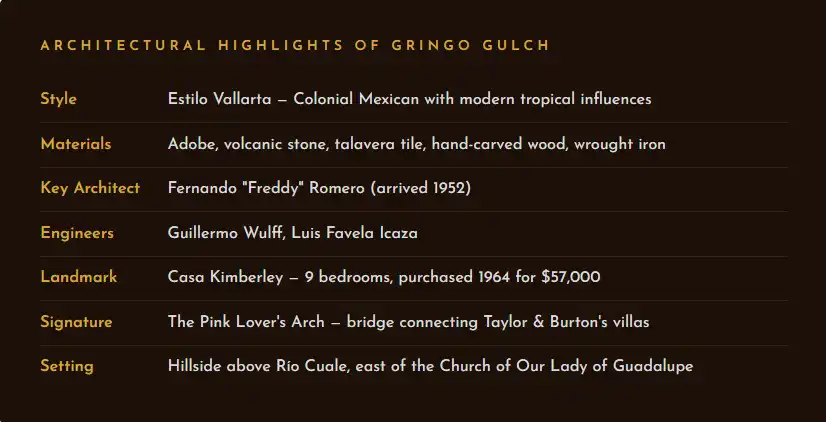
Architectural Highlights of Gringo Gulch
Style
Estilo Vallarta — Colonial Mexican with modern tropical influences
Materials
Adobe, volcanic stone, talavera tile, hand-carved wood, wrought iron
Key Architect
Fernando “Freddy” Romero (arrived 1952)
Engineers
Guillermo Wulff, Luis Favela Icaza
Landmark
Casa Kimberley — 9 bedrooms, purchased 1964 for $57,000
Signature
The Pink Lover’s Arch — bridge connecting Taylor & Burton’s villas
Setting
Hillside above Río Cuale, east of the Church of Our Lady of Guadalupe
06 · Timeline
How Puerto Vallarta Changed Forever
1851
Puerto Vallarta is officially founded. For the next century it remains a small fishing and agricultural settlement, known only to those who live there.
1951
The town’s centenary celebrations attract modest attention. The first American and Canadian expatriates begin arriving, drawn by the unspoiled beaches, cheap land, and the extraordinary quality of the light over Banderas Bay.
1952
Architect Fernando “Freddy” Romero arrives in Puerto Vallarta. He begins designing the villas that will define the visual character of Gringo Gulch and give birth to Estilo Vallarta.
1963
Director John Huston arrives to film “The Night of the Iguana” at Mismaloya. Richard Burton, Ava Gardner, and Deborah Kerr star. Elizabeth Taylor accompanies Burton. The world press descends on Puerto Vallarta.
February 1964
Richard Burton purchases Casa Kimberley for $57,000 as a birthday gift for Elizabeth Taylor’s 32nd birthday. He later buys the villa across the street and builds the famous pink Lover’s Arch bridge connecting the two homes.
1964–1970s
Hollywood’s elite flock to Gringo Gulch: Rock Hudson, Burt Lancaster, Peter O’Toole, John Wayne, Anthony Quinn, Ava Gardner, Leonard Bernstein, and many others. Puerto Vallarta’s international tourism industry is born.
1974
Taylor and Burton divorce for the first time. They remarry in 1975 in Botswana, then divorce again in 1976. Puerto Vallarta remains a touchstone for both.
1984
Richard Burton dies. Elizabeth Taylor, unable to return to Vallarta without him, sells Casa Kimberley and all its contents. An era ends.
Today
Gringo Gulch is a thriving historic neighborhood and major cultural attraction. Casa Kimberley operates as a luxury boutique hotel. The pink Lover’s Arch still stands, welcoming visitors from around the world to the hillside that changed Mexico forever.
07 · Visitor Guide
How to Experience Gringo Gulch Today
Gringo Gulch is one of Puerto Vallarta’s most rewarding neighborhoods to explore on foot — and one of the most easily reached. It lies just uphill from the Church of Our Lady of Guadalupe, whose extraordinary crown-shaped tower is the city’s most recognizable landmark, and a short walk from the Río Cuale footbridge that connects downtown to the Zona Romántica. The cobblestones and steep staircases are part of the experience: wear comfortable shoes and take your time.
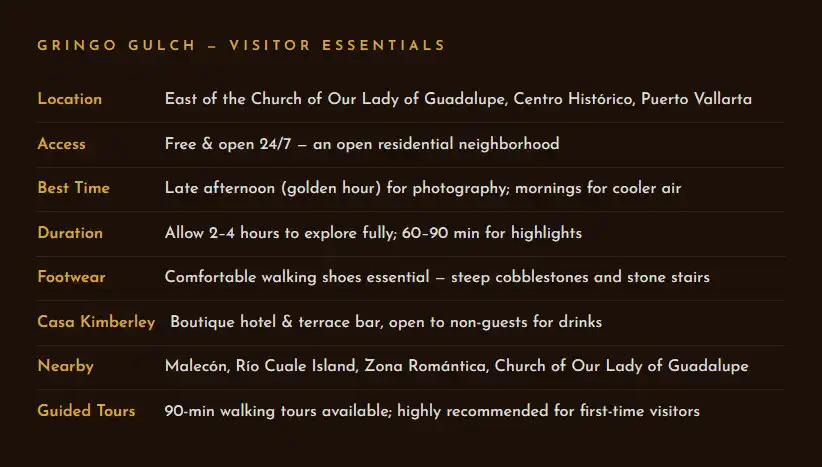
Plan to spend two to four hours wandering the neighborhood’s winding lanes. The late afternoon, when the low Pacific sun bathes the white walls and terracotta tiles in amber light and the bougainvillea seems to glow is the finest time to visit. Bring a camera. You will not stop taking photographs.
Puerto Valllarta Travel Guide Riviera Nayarit Ranks #1 Travel Guide for Puerto Valllarta Riviera Nayarit vs … https://promovisionpv.com/promovisionpv-com-travel-guide-ranks-1-vs/
Puerto Vallarta Advertise & Be Seen ! https://promovisionpv.com/puerto-vallarta-advertize-be-seen/
PromovisionPV emphasizes that Puerto Vallarta is more than just a beach town.
Neighborhood reviews and local advice are highly valued because they help travelers avoid tourist traps.
Practical Q&A format makes the guide stand out, it directly addresses the most common visitor concerns.
Search on PromovisionPV.com Travel Guide https://promovisionpv.com/search-on-promovisionpv-com-travel-guide/
Use the Search Bar and look on 1,500 Pages Somethings you may not know about Puerto Vallarta, Riviera Nayarit and Mexico. archives Puerto Vallarta, arts, Bucerias, Cirque du Soleil, Costa Alegre, culture, destination wedding, events, events schedule, gastronomy, gay pv, gay vallarta, informations, insurance, Jalisco, lgbtq, medical care, mexican food, Nayarit, news, Nuevo Nayarit, Punta Mita, Rincon de Guayabitos, safety, San Blas, San Pancho, Sayulita, See more
We provide information and resources for visitors to Puerto Vallarta, areas of The Riviera Nayarit and other destinations in both states of Jalisco and Nayarit . You will find variety of content, including articles, blog posts, videos, photos, descriptions and interviews, all of which are designed to help visitors plan their trip, including attractions, restaurants, and events. Follow: https://promovisionpv.com/

Visit and Subscribe to our YouTube Channel for more Puerto Vallarta – Riviera Nayarit 220+ videos: Subscribe: https://www.youtube.com/@promovision/videos
Follow: Web site: https://promovisionpv.com
Subscribe: YouTube: https://youtube.com/promovision/videos
Subscribe: Instagram: https://instagram.com/promovisionpv/
Follow: LinkedIn: https://www.linkedin.com/in/ray-dion-48861926/
Follow: Threads: https://www.threads.net/@promovisionpv
Follow: Facebook Group: https://www.facebook.com/groups/794486120348295
Follow: Blue Sky Social: https://bsky.app/profile/promovision.bsky.social